The enduring power of Winslow Homer’s canvases lies not merely in their technical brilliance or breathtaking realism, but in their raw, unvarnished portrayal of humanity grappling with the relentless forces of nature and the sea. Homer, a towering figure in American art, carved a unique path, a solitary voyager whose artistic journey mirrored the rugged landscapes and tempestuous waters he so masterfully depicted. His life story is one of keen observation, unwavering dedication, and a profound connection to the world around him, a narrative that continues to resonate with viewers nearly a century after his passing.
Winslow Homer was born on February 24, 1836, in Boston, Massachusetts, into a family with a rich, albeit somewhat bohemian, artistic lineage. His father, Charles Savage Homer, dabbled in painting, and his mother, Henrietta Benson Homer, was a watercolourist and amateur artist. This early exposure to the creative arts, though perhaps informal, undoubtedly sowed the seeds of Homer’s artistic inclinations. He was not, however, a child prodigy destined for academic acclaim. His early years were marked by a quiet disposition and a keen eye for detail, qualities that would later define his artistic practice.
A Young Man’s Education and Ambitions
Despite his burgeoning artistic talent, Homer’s formal education was somewhat practical. He attended the Massachusetts College of Pharmacy, a pragmatic choice that perhaps reflected his father’s hopes for a more stable profession for his son. However, the allure of the easel proved too strong to resist. Homer’s true education began not in lecture halls, but in the bustling streets and environs of Boston, where he honed his observational skills through sketching. He was a voracious learner, absorbing the visual vernacular of his surroundings like a sponge. His early work, often characterised by genre scenes and portraits, demonstrated a mature understanding of form and light, far exceeding that of many formally trained artists of his generation.
The Lithography Years: A Foundation in Craft
At the age of eighteen, Homer was apprenticed to John Bufford, a prominent lithographer in Boston. This period, lasting for several years, was instrumental in shaping his artistic discipline and technical proficiency. Lithography demanded precision, a meticulous attention to line, and an understanding of tonal gradation. Homer’s work during this time, primarily illustrations for publications like Harper’s Weekly, showcased his emerging talent for capturing narrative and atmosphere. These assignments, often depicting current events, rural life, and the burgeoning industrialisation of America, provided him with a broad range of subjects and experiences. It was during this apprenticeship that he learned the importance of translating complex visual information into a clear and compelling image, a skill that would serve him immensely as a painter.
Winslow Homer, renowned for his evocative depictions of American life and nature, has often been compared to other great artists who captured the essence of their surroundings. For those interested in exploring the broader context of art history, a fascinating read is the article on the State Hermitage Museum in St. Petersburg, Russia. This museum houses an extensive collection of artworks that reflect various artistic movements and styles, providing a rich backdrop against which to appreciate Homer’s contributions. To learn more about this remarkable institution, you can visit the article here: An Introduction to the State Hermitage Museum.
The New York Years and the Birth of a Painter
In 1859, Homer moved to New York City, the epicentre of American artistic and cultural life. This transition proved to be a pivotal moment in his career, marking his definitive shift from illustration to fine art painting. New York offered a wider audience, greater opportunities, and a more vibrant artistic community, although Homer would always remain something of an outsider. He enrolled briefly at the National Academy of Design, but, as with many self-taught or artistically inclined individuals of his era, he found academia to be somewhat stifling to his independent spirit.
A Freelance Illustrator in a Thriving Metropolis
Homer continued his work as an illustrator for Harper’s Weekly and other magazines, but his focus increasingly shifted towards his own artistic pursuits. The Civil War, which erupted shortly after his arrival in New York, provided a dramatic and poignant backdrop for his early paintings. His illustrations and paintings from this period, such as Home, from the War and The Prisoner of War, captured the human cost of conflict with a remarkable sensitivity and unflinching realism. These works, often rendered with a stark, unembellished honesty, were a departure from the more sentimental depictions of war prevalent at the time. He brought a ground-level perspective, a focus on the ordinary soldier and the profound impact of war on individuals and families.
The Genesis of a Master: Early Oil Paintings
It was in New York that Homer began to truly develop his distinctive painterly style. He experimented with oil paints, moving beyond the confines of line and tone. His early oils often depicted scenes of urban life, children at play, and genteel domesticity. Works like The Bridle Path and A Basket of Clams showcase his growing mastery of colour, light, and composition. However, there was already a discernible undercurrent of realism, a refusal to prettify his subjects, that hinted at the more powerful and dramatic themes he would later explore. He was not interested in mere representation; he sought to convey the essence of his subjects.
The Influence of Travel and the Sea’s Embrace
While New York offered a platform for Homer’s burgeoning career, it was his travels, particularly those to the coast, that would profoundly shape his artistic evolution. The sea, with its ever-changing moods and untamed power, became a recurring muse, a force that resonated deeply with Homer’s own independent spirit. He was drawn to its raw energy, its beauty, and its inherent danger.
Sojourns in Europe: A Brief Encounter
In 1866, Homer embarked on a trip to Europe, spending time in France, particularly Paris, and Italy. While he encountered the works of the Impressionists, their focus on fleeting light and subjective perception did not entirely captivate him. Homer’s artistic vision was more grounded in tangible reality, in the sturdy forms and enduring truths of the natural world. His time in France exposed him to the Barbizon School and their dedication to painting en plein air, a practice Homer wholeheartedly embraced. His Italian sojourn, however, proved more fruitful artistically, particularly his visit to the rural village of Cividale del Friuli, where he produced a series of sun-drenched watercolours and oil paintings depicting peasant life. These works demonstrated a newfound lightness of touch and a vibrant palette, suggesting a loosening of his earlier, more restrained style.
The Massachusetts Coast: A Lifelong Love Affair
Upon his return to America, Homer established a studio in Watertown, Massachusetts, but his artistic soul remained tethered to the rugged beauty of the New England coast. He would spend increasing amounts of time at Prout’s Neck, Maine, a windswept promontory that would become his permanent home and the subject of some of his most iconic works. The sea here was not a gentle backdrop but a formidable presence, a character in itself. He observed its every mood: the serene calm of a summer’s day, the violent fury of a storm, the ethereal mist that often clung to the coastline.
The Prout’s Neck Years: Capturing the Tempest and the Human Spirit
Homer’s move to Prout’s Neck in 1883 marked the final and arguably most significant chapter of his artistic life. Here, in near isolation, he found his definitive voice, distilling his observations and experiences into a body of work that is at once monumental and deeply personal. The sea, in all its magnificent and terrifying glory, became his primary subject, and he became its unparalleled interpreter.
Mastering the Elements: Storms and Shipwrecks
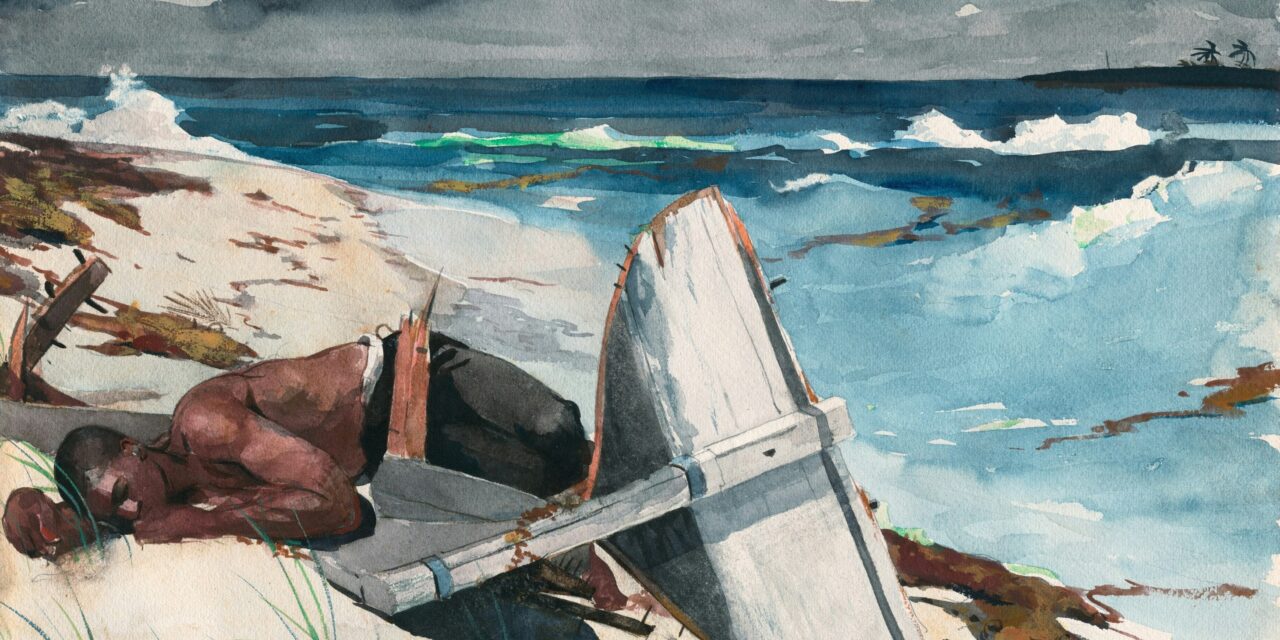
The paintings of Homer’s Prout’s Neck period are characterised by their dramatic power and their unflinching depiction of humanity’s struggle against the forces of nature. He was fascinated by the sea’s ability to both sustain and destroy, and he captured the brutal reality of maritime life with a visceral intensity. Works like The Fog Warning, Alligator Hunter, and The Gulf Stream are not merely depictions of boats or fishermen; they are profound meditations on courage, resilience, and the precariousness of existence. He rendered the churning waves, the relentless spray, and the muscular effort of those who dared to challenge the ocean with an astonishing economy of brushstroke and a masterful understanding of form. His figures, often solitary and stoic, embody a quiet defiance in the face of overwhelming odds.
The Watercolours of the Caribbean: A Luminous Shift
While his oils often conveyed the raw power of the northern seas, Homer’s visits to the Caribbean in the 1880s and 1890s resulted in a breathtaking series of watercolours, imbued with a luminous vibrancy and a sense of exoticism. These works, often depicting local inhabitants, lush tropical foliage, and the shimmering turquoise waters, reveal a different facet of his artistic genius. The immediacy of watercolour allowed him to capture the fleeting light and the saturated colours of the tropics with an astonishing spontaneity and freshness. Subjects like A Parrot, West Indian Boy with a Basket, and Palm Tree, Nassau showcase his ability to translate sensory experience into pure visual poetry. There is a joy and liberation in these watercolours that complements the gravitas of his seascapes.
Winslow Homer, renowned for his evocative depictions of American life and nature, has a fascinating life story that reflects his artistic evolution and the influences that shaped his work. To delve deeper into the broader context of artistic aspirations during his time, one can explore a related article that discusses the journeys of various artists and their creative processes. This insightful piece can be found here, providing a rich backdrop to understanding the environment in which Homer thrived.
Legacy and Enduring Significance
Winslow Homer’s artistic journey was a testament to independence, persistent observation, and profound artistic integrity. He was a man who charted his own course, both in his life and in his art, largely eschewing the prevailing trends of his time to pursue his own unique vision. His influence has reverberated through generations of artists, and his works continue to captivate and inspire audiences worldwide.
A Pioneer of American Realism
Homer is rightly celebrated as a leading figure of American Realism. He rejected romanticised notions and instead sought to capture the unvarnished truth of his subjects. Whether depicting the stoic fishermen of Maine, the resilient soldiers of the Civil War, or the vibrant life of the tropics, his paintings possess an undeniable authenticity. His dedication to painting directly from nature, of immersing himself in his subjects, allowed him to imbue his canvases with a palpable sense of place and experience. He was not an artist of the salon; he was an artist of the wharf, the battlefield, and the storm-tossed sea.
A Master of Light and Form
Beyond his thematic concerns, Homer’s technical prowess is undeniable. His mastery of light, particularly the dramatic interplay of light and shadow, is a hallmark of his work. He understood how light shaped form, how it revealed texture, and how it could evoke atmosphere and emotion. His early grounding in illustration and lithography provided him with a solid foundation in draughtsmanship, which he then translated into a bold and expressive painterly technique. His brushstrokes could be broad and powerful, conveying the energy of the sea, or delicate and precise, capturing the subtle hues of a watercolour.
A Solitary Genius of the Natural World
Winslow Homer’s life was, in many respects, a solitary one. He was not a gregarious figure in the art world and preferred the quiet contemplation of his studio and the embrace of nature. This isolation, however, allowed him to develop an intensely personal artistic vision, one that was deeply rooted in his own observations and experiences. His enduring significance lies in his ability to translate the raw beauty and inherent drama of the natural world into art that is both visually stunning and emotionally resonant. He taught us to see the strength, the vulnerability, and the profound beauty that exists in the face of overwhelming natural forces, leaving behind a legacy of work that continues to speak to the enduring human spirit.
FAQs
1. Who was Winslow Homer?
Winslow Homer was an American landscape painter and printmaker, best known for his marine subjects. He was born on February 24, 1836, in Boston, Massachusetts, and died on September 29, 1910, in Prouts Neck, Maine.
2. What are some of Winslow Homer’s most famous works?
Some of Winslow Homer’s most famous works include “The Gulf Stream,” “Breezing Up (A Fair Wind),” “Snap the Whip,” and “The Herring Net.” These paintings are renowned for their depictions of the sea and the lives of fishermen.
3. What was Winslow Homer’s artistic style?
Winslow Homer is known for his realistic depictions of the sea and the lives of fishermen, as well as his ability to capture the power and drama of nature. His style evolved over the course of his career, from detailed and precise to more loose and expressive.
4. What influenced Winslow Homer’s work?
Winslow Homer was influenced by the natural world, particularly the sea and coastal landscapes. He was also influenced by the work of other artists, such as the French Realists and the Barbizon School.
5. What is Winslow Homer’s legacy?
Winslow Homer is considered one of the greatest American painters of the 19th century. His work continues to be highly regarded for its technical skill, emotional depth, and powerful connection to the natural world. His legacy has had a lasting impact on American art and continues to inspire artists today.