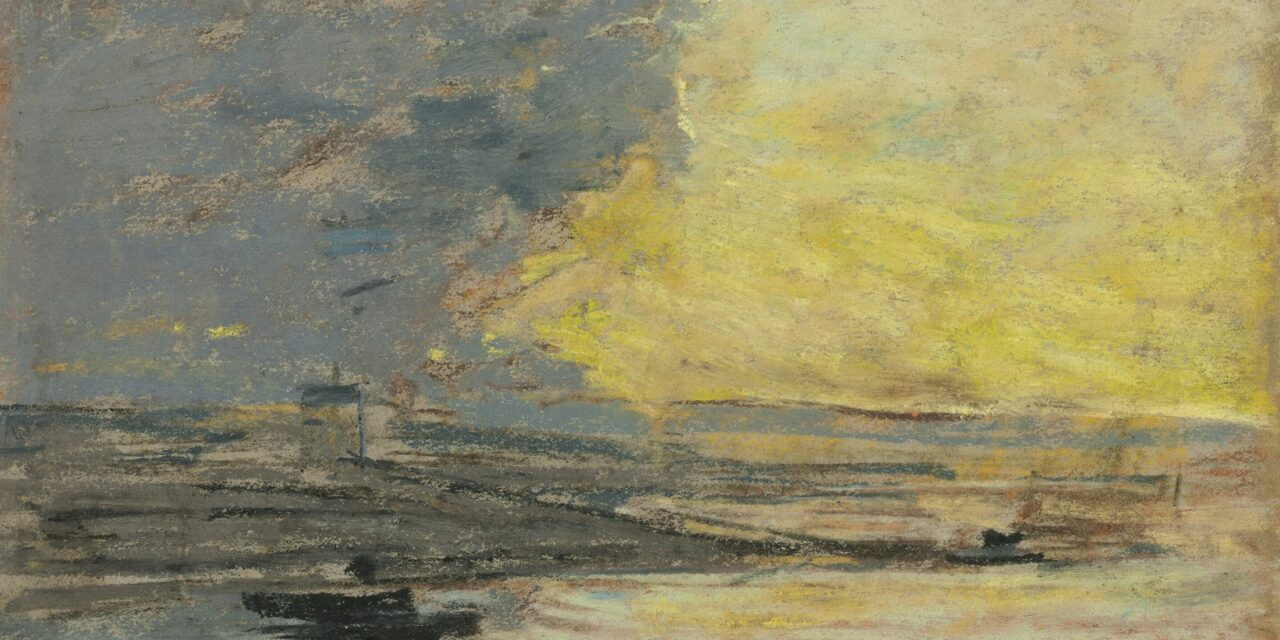
Eugène Boudin, a name often spoken in the same breath as the nascent stirrings of Impressionism, yet deserving of far greater recognition than merely being a precursor. He was a master of light, atmosphere, and the fleeting moments of coastline life, a painter who elevated the humble sketch to an art form and profoundly influenced a generation of artists, including Claude Monet himself. To truly understand Boudin is to appreciate the delicate dance between observation and emotion, the meticulous capture of nature’s ephemeral beauty, and the quiet revolution he instigated in the art world.
The Formative Years and Early Influences
Born in Honfleur, Normandy, in 1824, Eugène Louis Boudin’s early life was far removed from the refined salons of Paris. His father was a sailor, and Boudin himself spent his adolescence working on steamboats and later in a stationery and framing shop. This seemingly mundane background, however, proved to be a fertile ground for his artistic development. The bustling port of Honfleur, with its ever-changing skies, maritime activity, and constant ebb and flow of life, seeped into his consciousness, providing an unparalleled schooling in observation.
From Stationery to Sketchbook: The Seeds of an Artist
Boudin’s initial foray into art was humble. His stationery shop in Le Havre became a gathering place for local artists, including the likes of Jean-François Millet and Eugène Isabey. These seasoned artists, recognising the young Boudin’s innate talent and burgeoning interest in drawing, encouraged him to pursue his passion. They offered advice, lent him art books, and perhaps most crucially, provided a glimpse into a world beyond stationery and frames. This informal mentorship was invaluable, fostering Boudin’s self-taught artistic education and instilling in him a belief in the power of direct observation.
The Call of the Coast: Early Themes and Techniques
It was during these formative years that Boudin developed his lifelong fascination with the coast. The Norman beaches, with their distinctive light, dramatic cloud formations, and the interplay of land and sea, became his primary subject matter. Unlike many painters of his time who favoured grand historical or mythological scenes, Boudin was drawn to the ordinary, the everyday, elevating these seemingly mundane vistas into poetic studies of light and atmosphere. His early works often centred on seascapes, fishing boats, and the tranquil life of port towns. He began to experiment with plein air painting, a technique that would become central to his artistic identity, braving the elements to capture the nuances of light and colour as they truly appeared. This early dedication to working outdoors, directly from nature, set him apart from his contemporaries and laid the groundwork for the Impressionist movement.
For those interested in exploring the works of Eugène Boudin further, a related article that delves into the broader context of 19th-century art is available. This piece examines the painting “Golden Age” (1879-1885) by Hans von Marees, providing insights into the artistic movements and influences of the time. You can read more about it in the article here.
Boudin’s Artistic Revolution: The “En Plein Air” Master
Boudin’s signature artistic contribution unequivocally lies in his mastery of plein air painting. He wasn’t the first to venture outdoors with a sketchbook, but he was among the first to truly embrace and champion it as a central tenet of his artistic practice, transforming the quick outdoor sketch into a finished work of art.
Capturing the Ephemeral: Light, Atmosphere, and Moment
Boudin’s dedication to plein air painting stemmed from his profound understanding of light and atmosphere. He recognised that these elements were constantly in flux, changing with the time of day, the season, and the prevailing weather. His aim was not to render a static, idealised scene, but to capture the fleeting moment, the precise quality of light as it fell upon the water, the shifting patterns of clouds, and the ephemeral reflections on wet sand. This meticulous observation of transient effects led him to create works that possessed an extraordinary sense of immediacy and life. His brushstrokes, though not yet as broken and distinct as those of the later Impressionists, were nevertheless loose and suggestive, conveying movement and the shimmering quality of light.
The Humble Sketch Reimagined: Croquis and Finished Works
Crucially, Boudin didn’t view his plein air sketches as mere preparatory studies. He considered them complete works in themselves, each a direct and unadulterated response to nature. He called these smaller, direct-from-nature paintings croquis, and their freshness and spontaneity were highly valued. While he would sometimes use these croquis as inspiration for larger studio works, many of his most celebrated pieces are these vivid, direct observations. He meticulously noted the date, time, and atmospheric conditions on the back of his canvases, underscoring his scientific approach to capturing the ever-changing natural world. This elevation of the sketch to a finished artwork was a radical departure from academic tradition and profoundly influenced artists like Monet, who famously described Boudin’s skies as “the great lesson he gave me.”
The “King of Skies”: A Signature Subject
It is no exaggeration to describe Boudin as the “King of Skies.” His almost obsessive focus on the heavens, and his unparalleled ability to render their infinite variations, became his artistic hallmark.
The Ever-Changing Canvas Above: Clouds as Subject
For Boudin, the sky was not merely a backdrop; it was the primary subject. He painted clouds with an almost scientific precision, capturing their weight, texture, and the way light interacted with their forms. From dramatic, storm-laden cumulonimbus to delicate, wispy cirrus, Boudin demonstrated an encyclopaedic knowledge of cloud formations. He understood how clouds reflected and diffused light, how they cast shadows, and how they dictated the overall mood and light of a landscape. His skies are rarely static; they pulse with movement, their colours shifting from pearly greys and soft blues to fiery oranges and deep purples.
Beyond Landscape: Integrating Figures into Atmospheric Scenes
While his skies are undoubtedly his crowning glory, Boudin was also adept at integrating human figures into his atmospheric landscapes, particularly during his time painting the fashionable resorts of Trouville and Deauville. These elegantly dressed figures, strolling on the beach, observing the sea, or simply enjoying the seaside air, are not rendered with individual portraiture in mind. Instead, they are depicted as anonymous, colourful accents that punctuate the vastness of the sky and sea. They add a human element without detracting from the overarching atmospheric study. These scenes, often filled with parasols and crinolines, offer a fascinating glimpse into the nascent leisure culture of 19th-century France, all depicted under Boudin’s masterfully painted skies. His ability to fuse the grandeur of nature with the intimate details of human presence created a unique and captivating visual language.
Influence on Impressionism and Legacy
Boudin’s impact on the nascent Impressionist movement is undeniable, and his role as a pivotal figure in this artistic revolution is increasingly acknowledged. He wasn’t an Impressionist in the purest sense (his brushwork retained a certain cohesion that differed from the fragmented strokes of Monet or Renoir), but he laid essential groundwork.
“The Great Lesson”: Mentoring Claude Monet
Perhaps Boudin’s most famous legacy is his mentorship of a young Claude Monet. Monet, initially a caricaturist with little interest in landscape painting, recounted how Boudin “opened my eyes” to the beauty of the outdoors and the importance of working directly from nature. Boudin took Monet on open-air excursions, teaching him the discipline of observing and quickly capturing the changing light and atmosphere. Monet’s famous quote, “If Boudin has a talent, it is for the sky. He is a marvel, and for that alone, he can hold his own in the front rank of the masters,” speaks volumes about the profound respect and admiration he held for his mentor. This early guidance from Boudin proved transformative for Monet, setting him on the path that would lead to his revolutionary Impressionist canvases.
Paving the Way: Plein Air and the Focus on Light
Beyond his direct influence on Monet, Boudin’s persistent dedication to plein air painting and his unwavering focus on capturing the transient effects of light and atmosphere provided a crucial blueprint for the Impressionists. He demonstrated that ordinary subjects – a beach, a stretch of sky, a few figures – could be worthy of serious artistic exploration, challenging the academic hierarchy of subject matter. His ability to convey the sensory experience of a moment, rather than just its detailed appearance, prefigured the Impressionists’ embrace of subjective perception and the fleeting impression. His works resonate with a fresh, immediate quality that was utterly revolutionary for its time.
For those interested in exploring the works of influential artists, a related article on Arshile Gorky provides a fascinating insight into his painting “One Year the Milkweed” from 1944. This piece, much like the works of Eugène Boudin, showcases the evolution of artistic expression and the interplay of nature and emotion in art. You can read more about it in this detailed exploration of Gorky’s significant contributions to the art world.
Later Years and Enduring Appeal
As Boudin grew older, his artistic vision continued to mature, though his core themes remained steadfast. He travelled more extensively, visiting Venice, the south of France, and Belgium, but always returned to his beloved Normandy.
Expanded Horizons: Travel and New Perspectives
Boudin’s travels introduced new subjects and lights to his repertoire. Venice, with its unique canals and architecture, offered a fresh challenge to his mastery of light and reflection. His Venetian scenes, while distinct, still bore the unmistakable touch of his atmospheric sensitivity. Similarly, his visits to the south of France exposed him to a brighter, more intense light, which he captured with his characteristic freshness. Despite these new horizons, the pull of Normandy remained strong. He continued to paint the beaches and harbours of his homeland, returning to the familiar motifs with a renewed sense of observation, finding endless variations in the skies and seas that had inspired him from the beginning.
A Quiet Master’s Legacy: Recognition and Influence
Despite his immense talent and pivotal role, Boudin never achieved the same level of celebrity or financial success as some of his Impressionist successors during his lifetime. He remained a modest and dedicated painter, focused on his craft. However, his work was consistently admired by fellow artists and discerning collectors. Today, Boudin’s work is widely celebrated for its profound originality, its exquisite sensitivity to nature, and its undeniable historical significance. His delicate touch, his luminous skies, and his ability to encapsulate a sense of time and place continue to captivate viewers. He remains a beloved figure, a quiet master whose canvases offer a window into a world bathed in exquisite light and steeped in the poetry of the sea. His legacy is not just historical; it lies in the enduring beauty and evocative power of his paintings, which continue to inspire and delight, cementing his place as one of the most important and influential landscape painters of the 19th century.
FAQs
Who was Eugène Boudin?
Eugène Boudin was a French landscape painter and a pivotal figure in the development of Impressionism. He was known for his seascapes and beach scenes, and was a mentor to many of the Impressionist painters.
What was Eugène Boudin’s artistic style?
Boudin’s artistic style was characterized by his use of light and color to capture the fleeting effects of nature. He often painted en plein air, or outdoors, to capture the changing light and atmosphere.
What were some of Eugène Boudin’s most famous works?
Some of Boudin’s most famous works include “Beach Scene, Trouville”, “The Beach at Villerville”, and “The Port of Camaret”.
How did Eugène Boudin influence the Impressionist movement?
Boudin’s use of light and color, as well as his emphasis on capturing the effects of nature, had a significant influence on the development of Impressionism. He also mentored and influenced many of the key Impressionist painters, including Claude Monet.
What is Eugène Boudin’s legacy in the art world?
Eugène Boudin is remembered as a pioneering figure in the development of Impressionism and a master of capturing the effects of light and atmosphere in his paintings. His work continues to be celebrated and admired by art enthusiasts and collectors around the world.