Hans Arp: A Life Sculpted by Chance and Creativity
Hans Arp, a name synonymous with Dada, Surrealism, and the exploration of organic form, led a life as fluid and ever-changing as the biomorphic sculptures that became his hallmark. Born in Strasbourg, Alsace, a region that frequently shifted allegiances between France and Germany, Arp’s very identity was shaped by a liminal existence, a theme that would resonate throughout his artistic career. He was a poet as well as a sculptor and painter, a pioneer of collage, and a tireless advocate for art as a force for liberation and connection. His journey was not one of a single, unwavering path, but rather a series of intuitive leaps and profound collaborations that defied easy categorization.
Jean Arp, as he was then known, was born on September 16, 1886, in Strasbourg, Alsace-Lorraine. His father was German, and his mother French, a duality that instilled in him an early awareness of cultural fluidity. Strasbourg, nestled on the Rhine, was a city of bridges, both literal and metaphorical, and Arp’s childhood was spent in a landscape that embraced multiple traditions. This geographical and cultural crossroads would later find echoes in his artistic practice, where he sought to bridge the gap between disparate elements and celebrate the unexpected conjunctions of form and meaning.
A Fostering Environment for Artistic Inclination
Arp’s family was not particularly artistic, but they were supportive of his early inclinations. He received a solid education, and his burgeoning interest in art was evident from a young age. He began to sketch and paint, absorbing the visual world around him. However, it was not a formal academic path that initially beckoned, but rather a yearning for something more visceral, more authentic.
The Early Stirrings of Independence
Even in his youth, Arp displayed a restless spirit. He was not content with mere representation; he sought to understand the underlying principles of form and the raw essence of things. This early curiosity, coupled with his bicultural upbringing, laid the groundwork for his future rejection of conventional artistic norms. He was a young man on the cusp of a century poised for upheaval, and he would become one of its most eloquent artistic voices, questioning the very foundations of what art could be.
Hans Arp, a pivotal figure in the Dada movement and a renowned sculptor, painter, and poet, has a life story that reflects the tumultuous artistic landscape of the early 20th century. His innovative approach to art, characterised by organic forms and a playful spirit, continues to inspire contemporary artists. For those interested in exploring the broader context of creativity and artistic expression, a related article can be found at Capturing Creativity, which delves into the various ways artists channel their imagination into their work.
The Genesis of Dada and the Embrace of Chance
The outbreak of World War I was a cataclysmic event that shattered the complacency of Europe and irrevocably altered the course of artistic creation. For Hans Arp, the war was not just a global conflict; it was a deeply personal affront to reason and humanity. It was in the crucible of this despair and disillusionment that the seeds of Dada were sown, and Arp was one of its most vital architects.
Zurich and the Cabaret Voltaire: A Haven for the Disaffected
In 1915, Arp sought refuge in neutral Zurich, a city that became a magnet for artists and intellectuals fleeing the horrors of war. It was here, amidst the vibrant intellectual ferment of the Cabaret Voltaire, that Dada truly took flight. The Cabaret Voltaire, opened by Hugo Ball and Emmy Hennings, became a notorious hub for anti-art performances, manifestos, and provocations. Arp, alongside other luminaries such as Tristan Tzara, Richard Huelsenbeck, and Marcel Janco, embraced Dada’s radical embrace of absurdity, irrationality, and protest.
The Revolution of Collage: Breaking Down and Reassembling Reality
Arp’s experimentation with collage was a direct response to the chaos and fragmentation of the war. He began creating works by arranging torn paper fragments into compositions, often guided by chance. He famously stated, “I have always had a deep aversion to squares, which I consider cowardly and deceitful.” His collages, therefore, favoured irregular shapes and organic forms, reflecting a deliberate rejection of geometric order.
“Collage According to the Laws of Chance”
One of Arp’s most iconic methods involved letting torn paper pieces fall randomly onto a surface, then pasting them down in their new positions. This embrace of chance, or “automatism,” was not about relinquishing control entirely but about allowing the subconscious to play a significant role in the creative process. It was a way of tapping into a primal creativity, bypassing the dictates of conscious reason and societal convention. These works were not merely random arrangements; they were carefully considered juxtapositions that revealed unexpected harmonies and visual poems.
The Collision of Materials and Meanings
Arp’s collages were not limited to paper. He incorporated a variety of materials, further blurring the lines between art and everyday life. He saw the potential for art in discarded objects, in the detritus of existence. This democratic approach to materials mirrored Dada’s broader critique of the established art world and its hierarchies.
The Spirit of Play and the Critique of Logic
Dada, and Arp’s contribution to it, was characterized by a spirit of playful subversion. The movement sought to dismantle the traditional notions of beauty, reason, and purpose that had, in their view, led to the catastrophic war. Arp’s work, while often serious in its intent to critique, was imbued with a lightness and a sense of unexpected joy. He believed that art could be a form of liberation, a way to break free from the shackles of logic and embrace the inherent wonder of existence.
The Emergence of Surrealism and the Exploration of the Unconscious
As Dada began to wane, a new artistic movement emerged from its ashes: Surrealism. Hans Arp, with his established interest in the irrational and the spontaneous, was a natural fit for this new avant-garde. Surrealism, heavily influenced by the psychoanalytic theories of Sigmund Freud, sought to explore the realms of dreams, the unconscious mind, and the power of juxtaposition to reveal hidden truths. Arp’s work, while retaining its Dadaist roots, evolved to encompass the more dreamlike and symbolic qualities that characterized Surrealism.
Paris and the Surrealist Circle
In the early 1920s, Arp moved to Paris, the epicentre of the Surrealist movement. He became a close associate of André Breton, the principal theorist of Surrealism, and was a regular participant in the group’s activities, exhibitions, and publications. His contributions were crucial in shaping the visual language of Surrealism, even as he maintained a distinct individuality within the movement.
Biomorphic Forms: Sculptures that Breathe and Grow
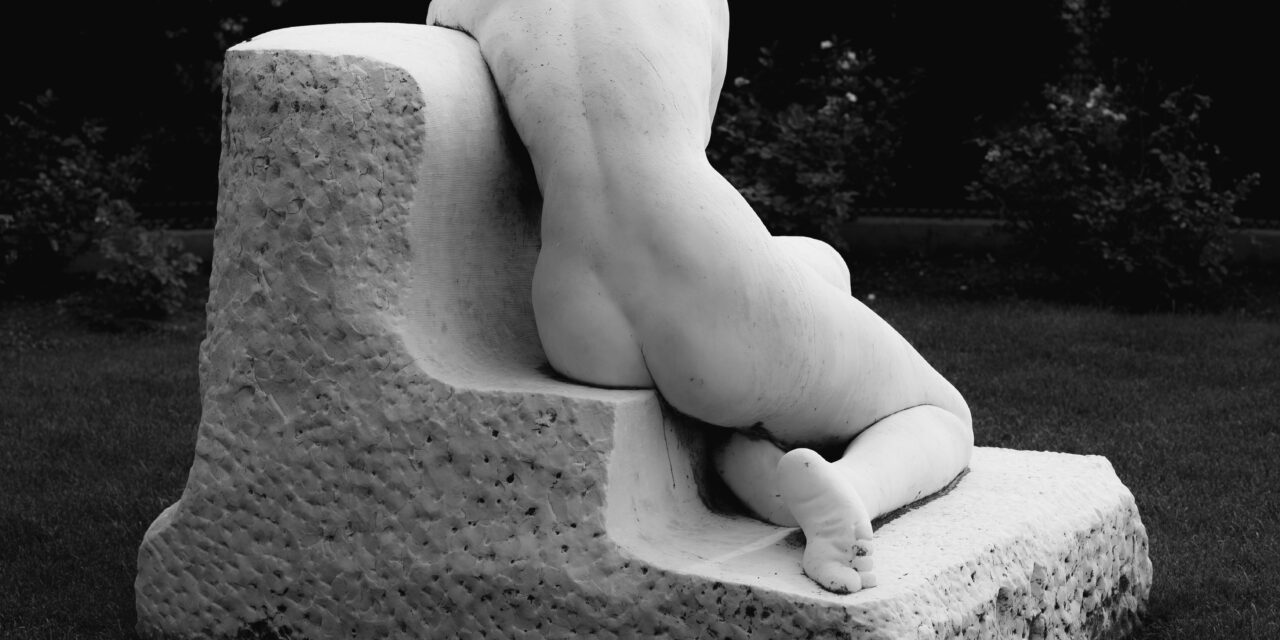
It was during his Surrealist period that Arp began to focus more intently on sculpture, developing his signature biomorphic forms. These sculptures, often carved from wood or cast in bronze, are characterized by their fluid, organic shapes, evoking natural elements like seeds, pebbles, or embryonic life. They possess a sense of inherent movement and growth, as if they have emerged from the earth itself.
“Human Concretions” and “Objects Without Aim”
Arp’s sculptures were rarely given titles that explained their meaning. Instead, he favoured evocative and often whimsical names such as “Human Concretions,” “Navels,” or “Objects Without Aim.” This deliberate ambiguity invited viewers to engage with the sculptures on a more intuitive level, allowing their own associations and interpretations to come to the fore. He sought to create objects that felt alive, that possessed an inner logic independent of human representation.
The Synthesis of Nature and Imagination
Arp’s biomorphic sculptures represent a profound synthesis of the natural world and the artist’s imagination. He wasn’t merely copying nature; he was distilling its essence, creating forms that felt both familiar and utterly new. These works are a testament to his belief that art could tap into a universal language of form, a language that transcended cultural and linguistic barriers.
The Power of Juxtaposition: Bringing Together the Unexpected
Like his Dadaist collages, Arp’s Surrealist works often played with unexpected juxtapositions. He believed that by placing disparate elements together, one could unlock new meanings and evoke surprising emotional responses. This principle extended to his poetry and his collaborations, where he sought to create a dialogue between different artistic languages.
A Life Dedicated to Art and Collaboration
Hans Arp’s artistic journey was not a solitary one. He thrived on intellectual exchange and collaboration, forging strong bonds with fellow artists and writers who shared his vision. His life was a testament to the power of community in fostering creativity and pushing artistic boundaries.
Sophie Taeuber-Arp: A Partnership of Equals
One of the most significant relationships in Arp’s life, both personally and artistically, was with Sophie Taeuber-Arp. A pioneering artist in her own right, Taeuber-Arp was a painter, sculptor, textile designer, and dancer. Their partnership, which began in Zurich, was one of profound mutual respect and creative synergy. They often collaborated on works, merging their distinct styles into unique hybrid creations.
Shared Visions, Individual Expressions
While they worked together on projects like Dadaist collages and abstract textile designs, both Arp and Taeuber-Arp maintained their individual artistic voices. They influenced each other profoundly, pushing each other to explore new avenues of expression. Taeuber-Arp’s geometric abstraction and her innovative approach to design complemented Arp’s more fluid biomorphism, creating a dynamic interplay between their artistic sensibilities. Her untimely death in 1943 was a devastating loss for Arp and for the art world.
The Influence of Merz and Kurt Schwitters
Arp’s engagement with Kurt Schwitters and his “Merz” concept was another crucial aspect of his artistic development. Schwitters, a German artist, created his own unique art movement based on found objects and everyday materials. His principle of “Merzbau,” an all-encompassing artistic environment, resonated with Arp’s desire to break down the barriers between art and life. Their shared belief in the transformative power of assemblage and the inherent beauty of the discarded was a significant influence on both artists.
Fostering Artistic Communities
Throughout his life, Arp was a central figure in various artistic communities. He was not content to work in isolation; he actively sought out dialogue and exchange with his peers. This collaborative spirit extended to his involvement with international art movements and exhibitions, where he helped to disseminate new ideas and foster a sense of global artistic solidarity.
Hans Arp, a pivotal figure in the Dada movement and a pioneer of abstract art, has a life story that intertwines creativity and innovation. His unique approach to sculpture and poetry has influenced countless artists and movements throughout the 20th century. For those interested in exploring the broader context of artistic expression during Arp’s time, a fascinating article can be found that delves into the diverse techniques and inspirations of various artists, which can be accessed here. This resource provides valuable insights into the palette of possibilities that shaped the art world, reflecting the spirit of experimentation that Arp embodied.
Later Years and the Enduring Legacy
Even as he entered his later years, Hans Arp’s creative energy remained undimmed. He continued to sculpt, paint, and write, exploring themes that had occupied him throughout his life. His legacy, however, extends far beyond his individual works; it lies in his profound impact on the trajectory of modern art and his unwavering belief in the liberating power of creativity.
A Return to Abstraction and Organic Forms
In his later career, Arp continued to refine his explorations of organic and biomorphic forms. His sculptures became more monumental, and his engagement with materials like bronze and polished stone demonstrated a mastery of his craft. He continued to imbue his work with a sense of life and movement, a testament to his enduring fascination with the natural world.
The “Plaques” and their Lyrical Qualities
Arp also produced a series of works known as “Plaques,” often made from painted wood or metal. These relief sculptures, with their curving lines and subtly shifting forms, possessed a lyrical quality that further enhanced his exploration of organic abstraction. They often evoked a sense of gentle landscape or flowing water, demonstrating his continued ability to translate natural phenomena into abstract visual poetry.
A Poet of the Visual and the Verbal
Arp’s poetic output is as significant as his visual art. His poems, often characterized by their brevity, their playfulness, and their exploration of everyday language, mirrored the spirit of his artistic work. He saw no division between the visual and the verbal, believing that both could serve as vehicles for exploring the complexities of human experience. His poetry often echoed the chance operations and unexpected juxtapositions found in his visual art, creating a rich and cohesive body of work.
“The Sun’s Torso” and other Collections
Arp published several volumes of poetry throughout his career, including “Die Wolkenpumpe” (The Cloud Pump) and “Le Soleil dans le poche” (The Sun in the Pocket). His poetic style was experimental and accessible, often using simple language to convey profound observations about life, nature, and art. He championed a spontaneous and intuitive approach to writing, much like his approach to creating art.
A Lasting Influence on Generations of Artists
Hans Arp’s influence on subsequent generations of artists is undeniable. His pioneering work in collage and his embrace of chance and automatism laid crucial groundwork for abstract expressionism and other movements that explored the subconscious and the spontaneous. His biomorphic forms continue to inspire sculptors and designers, and his commitment to art as a force for liberation remains a vital message for artists today. His legacy is not simply in the objects he created, but in the spirit of innovation and the unwavering belief in the boundless potential of human creativity. He reminds us that art can be found in the most unexpected places, and that true creativity often arises from embracing the unknown and allowing the accidental to lead us to profound discoveries. His life was a testament to the beauty of form, the power of chance, and the enduring human desire to connect with something larger than ourselves.
FAQs
Who was Hans Arp?
Hans Arp was a German-French artist, poet, and sculptor known for his abstract and biomorphic sculptures and paintings. He was a founding member of the Dada movement and later became associated with Surrealism and Constructivism.
What were some of Hans Arp’s major artistic contributions?
Hans Arp was known for his innovative use of organic forms and biomorphism in his sculptures and paintings. He also experimented with chance and spontaneity in his artistic process, creating works that were both playful and thought-provoking.
What is Hans Arp’s artistic style?
Hans Arp’s artistic style can be described as abstract, organic, and biomorphic. He often used natural forms and shapes as inspiration for his sculptures and paintings, creating works that blurred the line between the organic and the abstract.
What are some notable works by Hans Arp?
Some of Hans Arp’s notable works include “Squares Arranged According to the Laws of Chance,” “Torso with Buds,” and “Cloud Shepherd.” He also collaborated with other artists and architects on various public art projects and sculptures.
What is Hans Arp’s legacy in the art world?
Hans Arp’s legacy in the art world is significant, as he was a pioneering figure in the development of abstract and biomorphic art. His innovative use of form and his exploration of chance and spontaneity continue to influence artists and art movements to this day.