Juan Gris, a name that resonates with the vibrant, analytical spirit of Cubism, is often placed alongside Picasso and Braque as one of the movement’s foremost pioneers. Yet, his life story is a fascinating tapestry woven with threads of academic training, artistic evolution, and a distinctively personal vision that distinguished him from his contemporaries. Unlike the whirlwind biographical narratives that sometimes surround artistic titans, Gris’s journey was one of deliberate exploration and quiet dedication, a testament to his meticulous approach to both life and art.
Born José Victoriano González-Pérez on March 23, 1887, in Madrid, Spain, Juan Gris entered a world far removed from the bohemian salons of Paris that would later define his artistic career. His upbringing was decidedly middle-class, and his father, a prosperous businessman, instilled in him a sense of order and discipline. From an early age, however, a nascent artistic sensibility flickered within the young José. He was an avid observer of the world, his sketchbook a constant companion, filled with meticulous drawings of everyday objects and scenes.
Early Influences and Academic Training
The foundation of Gris’s artistic talent was built upon a solid academic grounding. He initially pursued engineering studies at the School of Arts and Manufactures in Madrid, a path that perhaps contributed to his later analytical and structural approach to painting. However, the call of art proved too strong to ignore. In 1902, he enrolled at the Academy of Fine Arts of San Fernando, where he studied under the tutelage of the respected realist painter, Manuel Bartolomé Cossío. This period was crucial for developing his technical skills, mastering draughtsmanship, and understanding the principles of form and perspective. He meticulously copied works from the Prado Museum, absorbing the lessons of Spanish masters like Velázquez and Goya, a deep appreciation for their mastery of light, composition, and psychological depth that would subtly inform his later abstract works.
The Move to Paris and the Genesis of a New Identity
In 1906, a pivotal decision reshaped the trajectory of his life. Driven by an insatiable hunger for artistic innovation and the magnetic pull of the Parisian avant-garde, José Victoriano González-Pérez moved to the French capital. It was here, amidst the burgeoning artistic ferment, that he adopted the pseudonym “Juan Gris,” a more evocative and distinct name that would become synonymous with his groundbreaking artistic contributions. Paris, at the turn of the 20th century, was a crucible of artistic experimentation, a city teeming with artists, writers, and intellectuals who were challenging established norms and forging new paths. Gris, with his quiet determination and keen intellect, was poised to become an integral part of this revolutionary landscape.
Juan Gris, a prominent figure in the Cubist movement, is celebrated for his innovative approach to form and colour, which has left a lasting impact on modern art. His life story is intricately woven with the evolution of artistic techniques during the early 20th century. For those interested in exploring the diverse methods that artists employed during this period, a related article on the art technique of cloisonné can provide valuable insights into the intricate processes that shaped artistic expression. You can read more about this fascinating technique in the article found here: An Introduction to the Art Technique Cloisonné.
Embracing Cubism: A Personal Interpretation of a Revolutionary Movement
Juan Gris’s arrival in Paris coincided with the nascent stages of Cubism, a revolutionary art movement spearheaded by Pablo Picasso and Georges Braque. While initially influenced by their groundbreaking work, Gris quickly developed his own unique style, characterized by a more ordered, structured, and lyrical approach to the fragmentation of form. He was not merely a follower but a thoughtful participant, contributing significantly to the movement’s evolution and its philosophical underpinnings.
Initial Encounters and Early Cubist Explorations
Gris’s early years in Paris were marked by a period of intense observation and learning. He frequented the studios of other artists, absorbing the revolutionary ideas that were circulating. His initial foray into Cubism, as seen in works like “The Factory at Pantin” (1909), demonstrates a clear engagement with the principles of Cubist analysis – the breaking down of objects into geometric planes and the depiction of multiple viewpoints simultaneously. However, even in these early works, there’s a discernible clarity and a more harmonious colour palette compared to the often more somber tones favoured by Picasso and Braque in their Analytical Cubism phase.
The Birth of Synthetic Cubism and Gris’s Unique Contribution
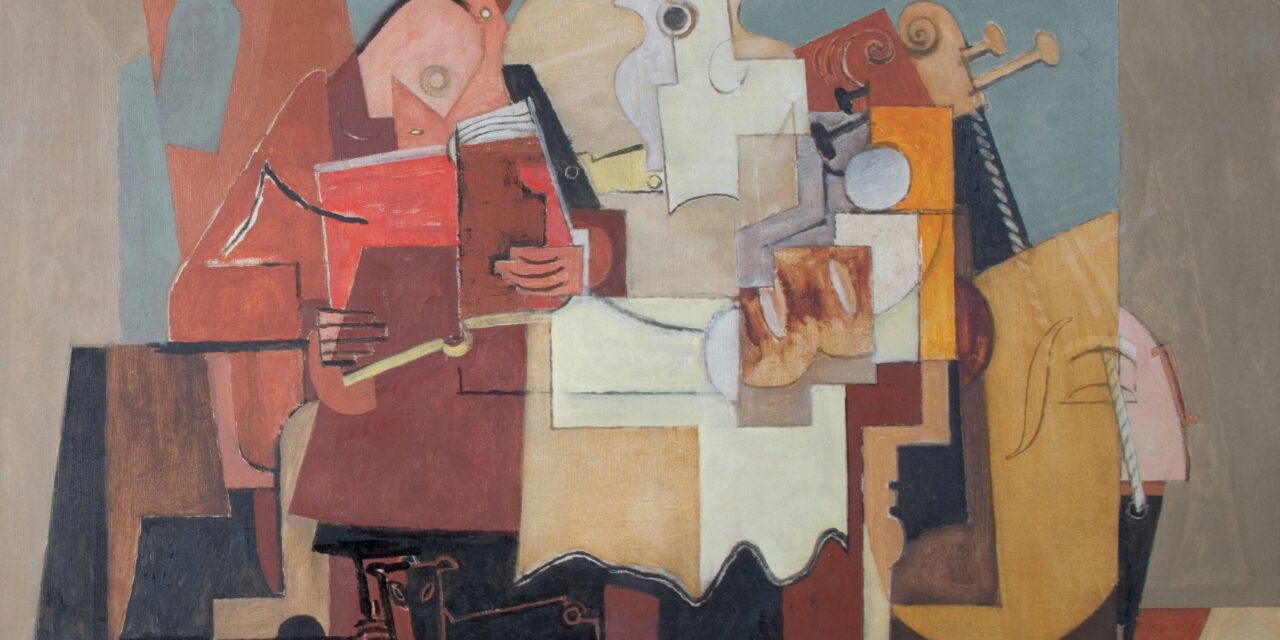
Gris is often credited with playing a vital role in the development of Synthetic Cubism. This phase of the movement, which emerged around 1912, saw artists incorporating new materials and techniques, such as collage and papier collé, and a move towards bolder colours and flatter planes. Gris’s “still-life” paintings from this period, like “Guitar and Fruit Bowl” (1913), exemplify his mastery of Synthetic Cubism. He introduced vibrant colours, simplified forms, and a sense of decorative elegance that was distinct from the more analytical and often muted approach of his contemporaries. His compositions were meticulously planned, with a strong emphasis on balance, rhythm, and the interplay of positive and negative space. He brought a certain intellectual rigor to the process, treating each element with deliberate consideration, much like a composer arranging musical notes.
Colour and Luminosity: A Gris Signature
One of the most striking aspects of Gris’s Cubist work is his masterful use of colour. While Picasso and Braque often explored a limited palette during their Analytical phase, Gris embraced a richer and more vibrant spectrum. He understood how colour could be used not just to describe form but to imbue his subjects with light and emotion. His colours are often luminous and harmoniously blended, creating a sense of joy and optimism even within the fragmented landscapes of Cubism. This deliberate use of colour became a signature element, distinguishing his work and adding a lyrical dimension to the otherwise analytical nature of the movement.
A Dedicated Practitioner and Intellectual Force
Beyond his technical prowess and stylistic innovations, Juan Gris was also a deeply thoughtful artist, committed to the intellectual underpinnings of Cubism. He engaged with theoretical discussions, wrote essays, and maintained a rigorous approach to his studio practice. His dedication to his art was unwavering, even in the face of personal hardship.
Studio Life and the Rigour of Creation
Gris’s studio was not a chaotic bohemian den but a meticulously organised space where ideas were cultivated and meticulously translated onto canvas. He worked with a methodical precision, often making numerous preparatory drawings and studies before embarking on a painting. This deliberate process allowed him to refine his compositions and explore the interplay of forms and colours with a deep sense of intellectual control. His studio was his sanctuary, a place where he could engage in focused contemplation and bring his unique vision to life.
Writings and Theoretical Contributions
While Picasso and Braque were primarily practitioners, Gris also contributed to the theoretical discourse surrounding Cubism. He wrote essays and statements that articulated his understanding of the movement, emphasizing its rational and constructive aspects. He believed that Cubism was not merely a stylistic experiment but a way of understanding and representing the complex reality of the modern world. His writings offered valuable insights into the philosophy of Cubism, revealing his deep engagement with its intellectual foundations and his commitment to pushing its boundaries.
Collaboration and Artistic Circles
Gris was an active participant in the Parisian art scene, forging close relationships with other artists and intellectuals. He exhibited alongside Picasso and Braque in influential shows, and his work was championed by prominent critics and dealers such as Daniel-Henry Kahnweiler, who became a lifelong supporter and friend. His interactions within these circles fostered a stimulating environment for artistic exchange and helped to solidify Cubism’s place in art history. He was respected for his integrity and his unwavering commitment to his artistic principles.
Personal Life and Enduring Legacies
Juan Gris’s personal life, though less tumultuous than some of his artistic peers, was nonetheless marked by significant events and enduring relationships that shaped his artistic output and left an indelible mark on art history. His unwavering dedication to his craft, despite personal challenges, speaks volumes about his character and his passion for painting.
Family and Relationships
In 1911, Gris married Josette Herard, a woman who provided him with steadfast support and companionship throughout his life. Their relationship was a source of stability and inspiration for the artist. He also maintained a close friendship with fellow artist and writer, Max Jacob, and later with the poet Guillaume Apollinaire, who recognized and championed his artistic genius. These relationships provided intellectual camaraderie and emotional support, crucial elements for any artist navigating the complexities of the art world.
Illness and Continued Dedication
Tragically, Gris’s life was cut short by illness. He suffered from kidney problems for many years, a condition that increasingly affected his health. Despite the debilitating nature of his illness, he continued to paint with remarkable resilience and unwavering dedication. His later works, while perhaps bearing the subtle imprint of his physical struggles, did not diminish the intensity of his artistic vision. Instead, they sometimes carried a poignant beauty, a testament to his enduring spirit and his commitment to his art until the very end.
Death and Lasting Impact
Juan Gris died prematurely on May 11, 1927, at the age of 40, in Boulogne-sur-Seine, France. His passing was a significant loss to the art world, leaving behind a relatively compact but profoundly influential body of work. His legacy, however, continues to thrive. His unique approach to Cubism, with its emphasis on colour, harmony, and structure, offered a distinct alternative to the dominant narratives of the movement.
Juan Gris, a prominent figure in the Cubist movement, is often celebrated for his innovative approach to form and colour, which can be further appreciated in the context of other artists of his time. For instance, the techniques employed by Rembrandt in his self-portrait reveal a contrasting yet equally compelling mastery of light and shadow. Exploring the intricacies of Rembrandt’s work can provide a deeper understanding of the artistic landscape that influenced Gris. To learn more about this fascinating connection, you can read an insightful article on Rembrandt’s self-portrait here.
The Enduring Brilliance of Juan Gris
Juan Gris’s artistic journey was one of continuous evolution, marked by a commitment to intellectual rigor, a masterful command of colour, and a personal vision that set him apart within the Cubist revolution. He was not merely an imitator but an innovator, a thoughtful artist who infused his work with a lyrical quality and a profound understanding of form and composition.
A Distinct Cubist Voice
Gris’s contribution to Cubism is undeniable. He took the radical deconstruction of form pioneered by Picasso and Braque and infused it with his own sense of order, clarity, and decorative sensibility. His Synthetic Cubist works, in particular, are characterized by their vibrant palettes, simplified yet expressive forms, and a harmonious balance that draws the viewer into a world of intellectual beauty. He demonstrated that Cubism could be both analytical and aesthetically pleasing, a complex intellectual pursuit imbued with a joyous visual experience.
The Legacy of Colour and Harmony
The luminous quality of Gris’s colours remains one of his most enduring and recognizable legacies. He understood how to use colour not merely as a descriptive tool but as a fundamental element of composition, imbuing his paintings with a sense of light, atmosphere, and emotional resonance. His harmonious colour relationships created a unique visual language that continues to captivate and inspire. He proved that the fragmentation of form did not necessitate a muted or somber aesthetic, but could be a vehicle for vibrant and harmonious expression.
Influence on Future Generations
Gris’s innovative approach to Cubism had a lasting impact on subsequent generations of artists. His integration of colour and form, his meticulous compositions, and his ability to imbue abstract art with a sense of lyrical beauty influenced artists working in various movements, including Constructivism and Abstract Expressionism. His emphasis on structure and order within abstraction provided a foundational vocabulary for artists seeking to explore the potential of geometric forms and chromatic harmonies. His work stands as a testament to the power of individual vision within a collective artistic movement, proving that even within the avant-garde, there is ample room for a singular and deeply personal artistic voice. His meticulous approach and his unwavering dedication to his craft continue to serve as an inspiration to aspiring artists and a rich source of study for art historians. Juan Gris, the quiet revolutionary of Cubism, left an indelible mark on the canvas of modern art.
FAQs
1. Who was Juan Gris?
Juan Gris was a Spanish painter and sculptor who was a key figure in the development of Cubism, an influential art movement of the early 20th century. He was born in Madrid in 1887 and moved to Paris in 1906, where he became associated with prominent artists such as Pablo Picasso and Georges Braque.
2. What are some of Juan Gris’ most famous works?
Some of Juan Gris’ most famous works include “The Sunblind” (1914), “Still Life with a Guitar” (1913), and “The Open Window” (1921). His paintings often featured still life compositions and were characterized by their geometric forms and use of colour.
3. How did Juan Gris contribute to the development of Cubism?
Juan Gris played a significant role in the development of Cubism by incorporating elements of collage and papier collé into his work. He also experimented with different perspectives and viewpoints, creating compositions that challenged traditional notions of representation in art.
4. What was Juan Gris’ artistic style and influences?
Juan Gris’ artistic style was characterized by his use of geometric shapes, bold colours, and fragmented forms. He was influenced by the works of Paul Cézanne and the Cubist paintings of Picasso and Braque, which inspired him to develop his own unique approach to the movement.
5. What was the legacy of Juan Gris?
Juan Gris’ legacy lies in his significant contributions to the development of Cubism and his influence on subsequent generations of artists. His innovative approach to composition and form continues to inspire contemporary artists, and his work is celebrated in major art institutions around the world.