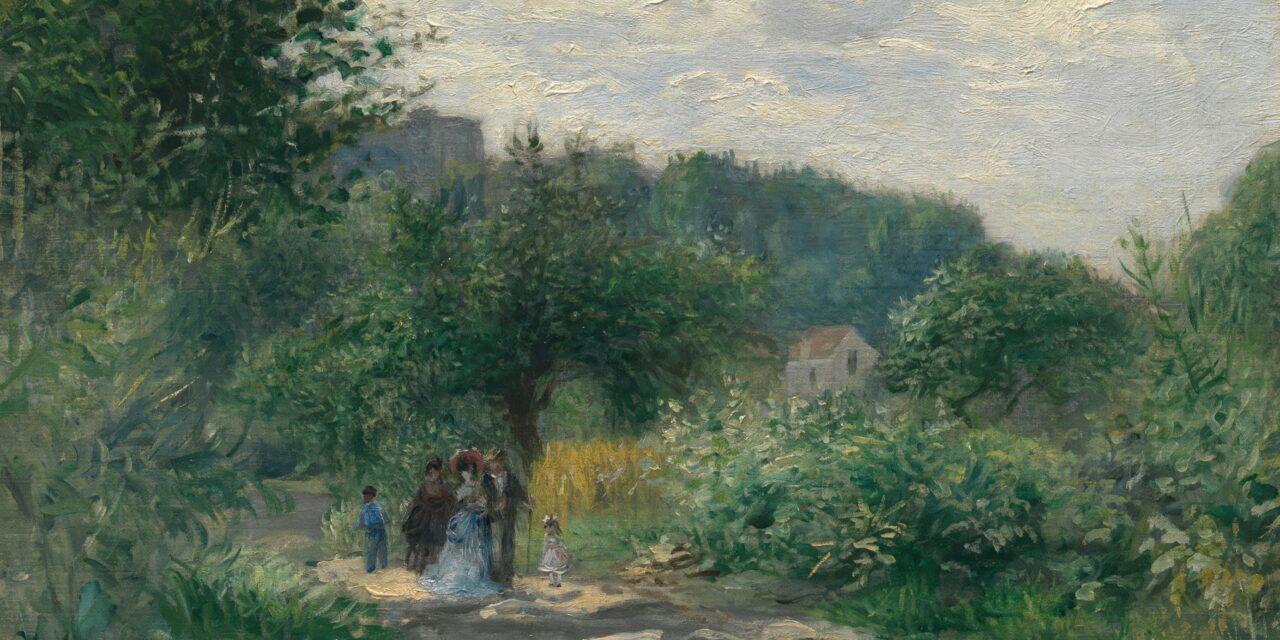
Pierre-Auguste Renoir, a name inextricably linked with the effervescence and radiant colour of Impressionism, was an artist whose life was as rich and vibrant as the canvases he left behind. Born in the bustling city of Limoges, France, in 1841, Renoir’s journey from humble beginnings to becoming one of the most beloved and influential painters of the 19th and early 20th centuries is a testament to his innate talent, relentless dedication, and an unwavering passion for capturing the fleeting moments of beauty and joy in everyday life. His story is not one of dramatic upheaval, but rather a steady, confident ascent, marked by profound artistic evolution and a deep connection to the human form and the natural world.
The Early Spark: A Potter’s Son’s Artistic Awakening
Renoir’s early life was steeped in the practical crafts of his family. His father, Léonard Renoir, was a tailor, and his mother, Marguerite, a seamstress. Yet, it was within this working-class environment that the artistic seed was sown. Unlike many of his Impressionist contemporaries who hailed from more privileged backgrounds, Renoir’s upbringing instilled in him a grounded appreciation for the tangible and the accessible.
A Natural Inclination for Colour and Form
From a young age, Pierre-Auguste displayed a remarkable sensitivity to colour and a natural inclination towards drawing. This nascent talent was recognised early on by his family, who, though not wealthy, supported his artistic aspirations. Before embarking on a path in fine art, Renoir honed his skills in a more commercial, yet equally artistic, trade: porcelain painting.
The Delicate Art of Porcelain
At the age of thirteen, Renoir began an apprenticeship at a porcelain factory in Limoges. Here, he developed a keen eye for detail, a steady hand, and an intimate understanding of delicate brushwork and vibrant glazes. This period, though seemingly a diversion from fine art, proved crucial in shaping his future artistic sensibilities. The meticulous application of colour, the mastery of delicate lines, and the creation of decorative beauty on a functional object all contributed to his later ability to imbue his canvases with a similar
lustre and refined detail. He learned to work with pigments that needed to withstand high temperatures, a discipline that would translate into his understanding of colour mixing and its permanence in his oil paintings. The very nature of porcelain painting, with its focus on light, form, and decorative appeal, foreshadowed his lifelong fascination with capturing the ephemeral glow of sunlight and the pleasing contours of the human figure.
The Move to Paris: A Gateway to Artistic Ambition
As his skills with porcelain painting became more sophisticated, Renoir yearned for a broader artistic education. The magnetic pull of Paris, the undisputed artistic capital of the world, became irresistible. Around the age of twenty, he made the momentous decision to move to the city, a step that would irrevocably alter the course of his life and art. Paris offered not only renowned academies and established artists but also a vibrant, burgeoning artistic scene that was beginning to challenge the rigid conventions of the time. It was here that his dream of becoming a painter, a true artist in the grand tradition, began to take shape. This move wasn’t a reckless leap of faith but a calculated step towards fulfilling a deeply felt calling, armed with the foundational skills acquired in his formative years.
Auguste Renoir, renowned for his vibrant use of colour and light, played a pivotal role in the Impressionist movement, capturing the essence of everyday life through his art. His life story is not only a testament to his artistic genius but also reflects the broader cultural shifts of his time. For those interested in exploring the evolution of artistic movements, a related article on Constructivism can provide valuable insights into how different styles, including Renoir’s Impressionism, have influenced modern art. You can read more about it in this article: An Introduction to Constructivism.
The Crucible of Impressionism: Forging a New Visual Language
Renoir’s arrival in Paris coincided with a period of immense artistic ferment. The established Salons, with their adherence to academic traditions and historical subjects, were beginning to face the challenge of a new generation of artists who sought to depict the modern world around them. Renoir found himself drawn into this revolutionary current, immersing himself in the studies and collaborations that would define the Impressionist movement.
Academic Training and Early Influences
Despite his burgeoning interest in modern subjects, Renoir, like many aspiring artists, initially sought formal training. He enrolled at the École des Beaux-Arts and studied under Charles Gleyre, a painter known for his historical and Orientalist scenes. While Gleyre’s style was not entirely aligned with Renoir’s eventual direction, the academic discipline provided a crucial foundation. More importantly, it was in Gleyre’s studio that Renoir met other like-minded artists who would become his lifelong friends and collaborators, including Claude Monet, Alfred Sisley, and Frédéric Bazille.
Friendships Forged in the Studio
The relationships forged during this formative period were instrumental. Renoir, Monet, Bazille, and Sisley formed a tight-knit group, sharing ideas, critiquing each other’s work, and embarking on plein air painting excursions together. This camaraderie was essential. It provided mutual support in the face of often harsh criticism from the academic establishment and fostered an environment of experimentation. They inspired each other to break free from traditional constraints, to observe the nuances of light and colour in the natural world, and to capture the fleeting impressions of their surroundings. This shared experience of exploring new artistic territories was the bedrock upon which the Impressionist movement was built.
The Allure of Plein Air Painting
The practice of plein air painting—working outdoors directly from nature—became a defining characteristic of Impressionism and a crucial technique for Renoir. This shift from the controlled environment of the studio to the chaotic, ever-changing conditions of the outdoors allowed artists to observe and render the effects of natural light and atmosphere with unprecedented fidelity. Renoir’s canvases from this period began to shimmer with the dappled sunlight filtering through trees, the iridescent colours of water, and the rosy hues of sun-kissed skin. He learned to capture the ephemeral, the fleeting moment, the sensation of being present in a specific time and place.
The Birth of the Impressionist Exhibitions
Frustrated by the repeated rejections from the official Salon and seeking a platform for their radical new style, Renoir and his fellow Impressionists took the bold step of organising their own independent exhibitions. The first of these, held in 1874 at the studio of the photographer Nadar, was a landmark event. It was here that the term “Impressionism” was coined, initially as a derogatory remark by a critic referencing Monet’s painting “Impression, Sunrise,” but later embraced by the artists themselves.
Challenging the Establishment
These independent exhibitions were acts of defiance against the entrenched art establishment. They allowed the Impressionists to directly present their work to the public, unfiltered by the judgments of the Salon jury. Renoir’s contributions to these early exhibitions showcased his burgeoning mastery of capturing light and movement, his focus on contemporary Parisian life, and his characteristic warmth and vibrance. His paintings from this era, such as “La Loge” (1874) and “Bal du moulin de la Galette” (1876), became iconic examples of Impressionist art, celebrated for their lively depiction of social gatherings and their exquisite rendering of light and shadow. These works were not just paintings; they were windows into a joyful, modern world, rendered with a brushstroke that captured the very essence of a moment.
The Radiant Palette: Capturing Joy and Light
Renoir’s artistic vision was, above all, an ode to beauty, joy, and the ephemeral pleasures of life. While other Impressionists might have explored the more melancholic or transient aspects of modern existence, Renoir consistently gravitated towards themes that celebrated the human spirit and the richness of visual experience. His paintings are saturated with a luminous quality, a testament to his extraordinary ability to harness light and colour.
The Lure of the Figure: Women and Children
Renoir’s enduring fascination with the human figure, particularly women and children, is perhaps his most recognisable hallmark. He possessed an uncanny ability to capture the innocence of childhood, the gentle allure of young women, and the quiet dignity of motherhood. Unlike some of his contemporaries who might focus on the psychological depths of their subjects, Renoir was captivated by their physical presence, their spontaneous gestures, and the way light played upon their skin.
The “Rosy Tint” of Youth
His portraits, whether commissioned or informal, radiated a warmth and vitality. He favoured soft, luminous flesh tones, often achieved through a delicate layering of warm pinks, oranges, and yellows, earning him a reputation for painting with a “rosy tint.” This was not mere superficiality; it was a conscious choice to imbue his subjects with a sense of life, health, and inner radiance. The children in his paintings often possess an uninhibited joy, their movements captured with a carefree fluidity. The women are depicted with a sensuous grace, their beauty celebrated rather than objectified.
Intimacy and Everyday Moments
Renoir excelled at capturing intimate moments of domestic life and leisure. His paintings often depict mothers with their children, women engaged in domestic tasks, or friends sharing a moment of conversation. These scenes, rendered with his characteristic dappled light and vibrant palette, elevate the ordinary to the extraordinary, finding beauty in the simple, everyday occurrences of life. He painted them not as grand narratives but as vignettes of genuine human connection and quiet happiness.
The Sensory Experience: Light, Colour, and Texture
Renoir’s approach to colour and light was revolutionary. He moved away from the somber palettes of academic painting, embracing a brighter, more vibrant spectrum. He understood how light altered the perception of colour, how shadows were not simply dark voids but filled with reflected light and subtle hues.
The Dance of Sunlight and Shadow
His canvases often feel alive with the play of sunlight. Whether depicting a sun-drenched garden, a busy Parisian café, or a figure bathed in natural light, Renoir masterfully captured the shimmering, transient qualities of illumination. His brushstrokes, often short and broken, mimicked the way light itself seemed to break and dance. The shadows in his work are rarely flat; they are rich with colour, reflecting the surrounding environment and hinting at the presence of light elsewhere. This technical prowess allowed him to create an almost tangible sense of atmosphere and depth.
A Tactile Quality in Paint
Beyond the visual, Renoir’s paintings often possess a distinctly tactile quality. His masterful handling of paint, particularly in his later work, created surfaces that seemed to invite touch. The smooth, luminous skin of his figures, the soft folds of fabric, and the textured surfaces of nature are all rendered with a palpable sensuousness. This ability to translate visual sensation into a nearly physical experience is a hallmark of his genius and contributes to the enduring appeal of his work.
Later Years and Evolving Artistic Concerns
As Renoir aged, his artistic journey continued to evolve. While he remained steadfast in his commitment to beauty and colour, his later works explored new directions, often in response to physical challenges and changing artistic landscapes. His enduring spirit and dedication to his craft allowed him to overcome adversity and continue creating until the very end of his life.
The Struggle and Triumph Over Physical Ailments
The latter part of Renoir’s life was marked by significant physical challenges, most notably the onset of severe rheumatoid arthritis. The debilitating effects of this condition made it increasingly difficult for him to hold brushes and move freely. At times, he could only paint with his brush strapped to his hand or by having his brush held for him by his son, Jean, or his loyal assistant, Gabrielle Renard.
The Resilience of the Artist’s Spirit
Remarkably, Renoir’s spirit and artistic drive were not diminished by his illness. Instead, he found new ways to continue his work, often adapting his techniques to accommodate his physical limitations. This period, far from being one of artistic decline, saw a deepening of his expressive powers and a renewed focus on certain aspects of his art. His ability to persevere in the face of such profound physical struggle is a testament to his unwavering dedication to his calling.
The Classical Revival and the Influence of Renaissance Masters
In his later years, Renoir experienced a period of what art historians refer to as his “Ingres period” or “Renaissance period.” This was a conscious turn towards more classical forms and a renewed appreciation for the linearity and sculptural qualities of the Old Masters, particularly Titian and Raphael.
Rediscovering Line and Form
While never abandoning his Impressionist roots, Renoir began to place a greater emphasis on clear outlines, solid modelling of form, and a more monumental approach to his subjects. This shift is evident in his nudes and portraits from this era, where the figures possess a sculpted quality and a sense of timeless permanence. It was not a rejection of Impressionism, but rather an expansion of his artistic vocabulary, incorporating lessons from art history to enrich his understanding of form and structure. The vibrant colour and luminous light remained, but they were now anchored by a stronger sense of drawing and composition.
The Enduring Legacy of his Drawings
It is in this later period, and indeed throughout his career, that the importance of Renoir’s drawings becomes increasingly apparent. While he is primarily celebrated as a painter, his prodigious output of sketches, studies, and illustrations reveals a profound and consistent engagement with line and form. The upcoming exhibition of his drawings in Autumn 2025, the first in over a century, promises to shed new light on this vital aspect of his oeuvre. These works, from early charcoal sketches to more finished illustrations for publications, demonstrate the rigorous foundation upon which his painterly achievements were built. They highlight his dedication to capturing everything from fleeting gestures to carefully composed figures, showcasing a draftsman’s precision beneath the painter’s vibrant touch. This exhibition aims to reclaim Renoir’s prominence, reminding us of his foundational role in Impressionism and revealing the breadth of his artistic exploration beyond his most famous oil paintings.
Auguste Renoir, renowned for his vibrant depictions of social gatherings and intimate moments, has often been compared to other influential artists of his time. For those interested in exploring the evolution of artistic expression, a fascinating read is available in an article that delves into the painting “The Great Friends” by Georg Baselitz. This piece highlights the ways in which contemporary artists draw inspiration from their predecessors, much like Renoir did in his own work. You can find the article here: The Great Friends.
Renoir’s Place in Art History: A Legacy of Light and Life
Auguste Renoir’s impact on the art world is undeniable. As one of the leading figures of Impressionism, he helped to forge a new way of seeing and depicting the world. His legacy is not merely in the collection of beautiful paintings he left behind, but in the enduring influence he had on subsequent generations of artists and in the way he brought joy and optimism into the realm of fine art.
The Quintessential Impressionist with a Unique Voice
Renoir embodied the spirit of Impressionism with his focus on light, colour, and capturing the fleeting moments of everyday life. Yet, he was never simply a follower of trends. He developed a distinctive style, characterised by its warmth, sensuousness, and unshakeable optimism. While Monet might capture the atmospheric effects of light and Degas the movement of dancers, Renoir’s unique contribution was his celebration of human beauty and the simple pleasures of existence. He painted the world not as it was, but as it felt, imbuing his subjects with an inner radiance.
A Foundation for Impressionism
The exhibition planned for Autumn 2025, focusing on his drawings, is particularly significant in its aim to “reclaim Renoir’s prominence” as a foundational figure in Impressionism, marking 150 years since the movement’s inception in 1874. By presenting over 100 sketches and artistic creations, it will underscore his deep engagement with artistic fundamentals throughout his career – from his youthful charcoal studies to his sophisticated illustrations. This exhibition will reveal the vast array of his work in drawing, demonstrating that his inventive spirit and artistic explorations extended far beyond the Impressionist era. It highlights his integral role in establishing Impressionism as a revolutionary force.
Enduring Popularity and Artistic Influence
Renoir’s works continue to be among the most popular and widely recognised paintings in the world. Their accessibility, their inherent beauty, and the inherent joy they convey resonate deeply with audiences across generations. He elevated the ordinary subject matter – picnics, family gatherings, portraits of ordinary people – to an art form, making art feel less distant and more relatable.
Inspiring Future Generations
His influence can be seen in the works of countless artists who followed, both within Impressionism and beyond. His mastery of colour and light, his sensitive portrayal of the human form, and his ability to capture a sense of lived experience continue to inspire painters, illustrators, and artists of all disciplines. His legacy is a reminder that art can be a source of profound beauty, emotional connection, and enduring optimism, a vibrant testament to the power of artistic vision. Renoir’s life story is a continuous exploration of light and life, a painterly journey that continues to illuminate and inspire.
FAQs
1. Who was Auguste Renoir?
Auguste Renoir was a French artist who was a leading painter in the development of the Impressionist style. He was known for his vibrant and sensual paintings, particularly of the female form and the beauty of nature.
2. What are some of Auguste Renoir’s most famous works?
Some of Auguste Renoir’s most famous works include “Luncheon of the Boating Party,” “Dance at Le Moulin de la Galette,” and “Bal du moulin de la Galette.” These paintings are celebrated for their use of light and color, as well as their depiction of everyday life in 19th-century Paris.
3. What was Auguste Renoir’s artistic style?
Auguste Renoir was a key figure in the Impressionist movement, known for his use of loose brushwork and emphasis on capturing the effects of light and color. His paintings often depicted scenes of leisure and pleasure, and he was particularly skilled at portraying the human form.
4. What was Auguste Renoir’s personal life like?
Auguste Renoir was born in Limoges, France, in 1841. He faced financial struggles early in his career but eventually achieved great success as an artist. He married Aline Charigot, with whom he had three sons. Despite suffering from severe rheumatoid arthritis in his later years, Renoir continued to paint and produce art until his death in 1919.
5. What is Auguste Renoir’s legacy in the art world?
Auguste Renoir’s legacy in the art world is significant. His contributions to the Impressionist movement and his unique style of painting have had a lasting impact on the art world. His works continue to be celebrated and admired by art enthusiasts and collectors around the world.