The avant-garde movements of the early 20th century were hotbeds of innovation, challenging established norms and forging new paths for artistic expression. Among the multitude of brilliant minds who contributed to this revolutionary era, César Domela Nieuwenhuis stands as a testament to the power of artistic evolution, cross-cultural influence, and an unwavering commitment to the principles of abstraction. From his early days in Amsterdam to his influential role within De Stijl and beyond, Domela’s life was a vibrant tapestry woven with artistic exploration, intellectual curiosity, and a relentless pursuit of a new visual language.
Early Life and Artistic Awakening
Born Cornelis Domela Nieuwenhuis in Amsterdam in 1900, the artist who would later become known simply as César Domela hailed from a family deeply rooted in intellectual and political radicalism. His father, Ferdinand Domela Nieuwenhuis, was a prominent socialist politician, a figure of considerable influence in Dutch society. This progressive upbringing, steeped in discussions of social change and challenging the status quo, undoubtedly laid the groundwork for Domela’s own future embrace of revolutionary artistic ideas.
The Lure of Self-Taught Artistry
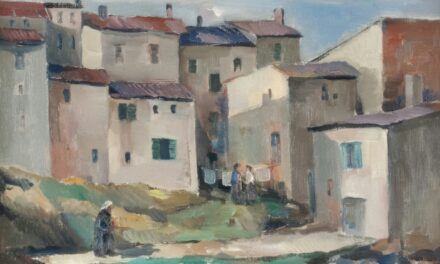
Unlike many of his contemporaries who received formal art education from established academies, Domela was largely self-taught. This autodidactic approach, while perhaps challenging in its initial stages, offered him a unique freedom from traditional constraints. He was free to explore, experiment, and develop his own artistic voice without the heavy hand of academic dogma. His early artistic inclinations gravitated towards drawing and watercolour, capturing landscapes and portraits with a nascent talent that hinted at the sophisticated draughtsmanship to come.
The Move to Switzerland: A Formative Period
In 1919, seeking to escape the lingering shadows of the First World War and perhaps to forge his own identity away from his father’s considerable shadow, Domela moved to Switzerland. This period proved to be profoundly formative. Here, he encountered the burgeoning world of avant-garde art, absorbing the lessons of Cubism and Futurism, movements that were dismantling traditional representation and exploring new ways of depicting space, time, and form. This exposure to radical artistic theories ignited a spark within him, pushing him towards a more abstract and conceptual approach to his work. His early Swiss paintings, while still containing vestiges of figuration, began to exhibit a nascent geometric purity, hinting at the direction his art would soon take.
César Domela, a prominent figure in the world of modern art, has a life story that intertwines with various artistic movements and influences. For those interested in exploring the broader context of art during his time, a related article delves into the significance of historical paintings, such as “Miracle of the Relic of the Cross at the Ponte di Rialto” by Vittore Carpaccio. This piece not only highlights the artistic techniques of the Renaissance but also reflects the cultural and societal shifts that shaped the era. To read more about this fascinating work, you can visit the article here.
De Stijl and the Pursuit of Universal Harmony
It was his return to the Netherlands in the early 1920s that marked a pivotal turning point in Domela’s artistic trajectory. He quickly became acquainted with the influential Dutch art movement, De Stijl, a group of artists and architects advocating for a radical form of abstraction based on geometric forms and primary colours.
Meeting Theo van Doesburg and Piet Mondrian
Domela’s introduction to De Stijl came through the movement’s charismatic founder, Theo van Doesburg. Van Doesburg, a dynamic and intellectually rigorous figure, recognised Domela’s potential and quickly welcomed him into the fold. It was through this association that Domela also met Piet Mondrian, the movement’s most celebrated proponent of Neoplasticism. The principles of De Stijl – the reduction of art to its fundamental elements, the use of horizontal and vertical lines, and a limited palette of primary colours, black, white, and grey – resonated deeply with Domela’s burgeoning aesthetic. He saw in these principles a path towards universal harmony and a rejection of subjective emotion in favour of objective order.
Contributing to De Stijl Magazine
Domela became an active contributor to De Stijl magazine, the movement’s influential periodical, publishing articles and showcasing his developing abstract works. His early De Stijl paintings, such as “Composition No. 1” (1924), exemplified the movement’s core tenets: carefully balanced geometric compositions, planar forms, and a restricted colour palette. However, even within the strictures of De Stijl, Domela’s individual voice began to emerge. He brought a certain lightness and dynamism to his compositions, a subtle departure from the often rigid formality of some of his peers. He experimented with varying thicknesses of lines and the precise placement of forms, seeking a delicate equilibrium within the abstract framework.
Beyond the Flat Canvas: Reliefs and Three-Dimensionality
While firmly rooted in the principles of De Stijl, Domela was not content to remain solely within the two-dimensional plane of painting. He soon began to push the boundaries of the movement, introducing an element that would become a defining characteristic of his mature work: the relief.
The Allure of Sculptural Painting
Domela’s exploration of reliefs in the mid-1920s was a significant innovation. He sought to break free from the illusionistic depth of traditional painting, instead creating actual, physical depth within his compositions. By incorporating various materials – metal, wood, and glass – and raising elements from the surface of the canvas, he blurred the lines between painting and sculpture. These “sculptural paintings” engaged the viewer in a more tactile and dynamic way, as the play of light and shadow on the raised surfaces became an integral part of the artwork. This move towards three-dimensionality was a radical step, challenging the very definition of painting within the De Stijl movement.
Incorporating Diverse Materials
The use of diverse materials was crucial to Domela’s relief work. He was a meticulous craftsman, carefully selecting and combining materials to achieve specific textural and visual effects. Polished brass might sit alongside matte wood, and transparent glass could be juxtaposed with opaque painted surfaces. This material richness added another layer of complexity and sophistication to his abstract compositions. His reliefs were not merely paintings with added elements; they were carefully constructed assemblages, each component playing a vital role in the overall aesthetic. Works like “Relief No. 36” (1929) demonstrate his mastery of this innovative approach, with planes of metal and wood interacting to create a dynamic interplay of light and form.
The Parisian Years and International Recognition
In 1927, Domela moved to Paris, a city that was then the undisputed epicentre of the international art world. This relocation proved to be another crucial turning point, broadening his artistic horizons and solidifying his reputation on a global stage.
Engagement with Abstract-Création
In Paris, Domela quickly became involved with the influential group Abstract-Création, an organisation dedicated to promoting geometric abstraction. His fellow members included prominent figures such as Jean Arp, Sophie Taeuber-Arp, and Georges Vantongerloo. This environment of like-minded artists fostered further experimentation and intellectual exchange. Within Abstract-Création, Domela continued to refine his relief work, pushing the boundaries of material exploration and formal innovation. He became a leading voice in the group, contributing significantly to the discourse surrounding abstract art.
Exhibitions and Growing Acclaim
The Parisian years saw Domela’s work exhibited extensively, gaining him international recognition. He participated in numerous group shows and solo exhibitions, introducing his distinctive reliefs to a wider audience. His innovative approach to combining painting and sculpture, coupled with his meticulous craftsmanship and sophisticated understanding of abstract principles, captivated critics and collectors alike. His works were acquired by major museums and private collections, cementing his place as a significant figure in the avant-garde. This period also saw him experimenting with photography and graphic design, demonstrating his versatile artistic talents and his engagement with different forms of visual communication.
César Domela’s artistic journey is a fascinating exploration of innovation and expression, reflecting the broader trends in the art world. For those interested in how contemporary artists can leverage social media platforms to enhance their visibility and connect with audiences, a related article offers valuable insights. You can read more about this topic in the article on social media marketing for artists, which discusses strategies for platforms like Instagram and TikTok. This resource can be found here.
Later Life and Enduring Legacy
Domela remained in Paris for the rest of his life, continuing to work and innovate. The tumultuous events of the mid-20th century, particularly the Second World War, undoubtedly impacted his creative output, but his commitment to abstract art remained unwavering.
Sustained Innovation in Reliefs
Throughout his later career, Domela continued to explore and refine his relief technique. He experimented with new materials, such as plexiglass and aluminium, and introduced more complex layering and spatial arrangements. His later reliefs often exhibited a greater sense of fluidity and movement, with curved lines and organic forms subtly integrated into his geometric compositions. While always retaining the underlying principles of abstraction, his work evolved, demonstrating a continuous process of artistic growth and exploration. He never settled into a predictable style, always seeking fresh ways to express his visual ideas.
A Lasting Impact on Abstract Art
César Domela passed away in Paris in 1992, leaving behind a profound and lasting legacy. His pioneering work in reliefs significantly expanded the possibilities of abstract art, bridging the gap between painting and sculpture. He demonstrated that abstraction was not merely a stylistic choice but a powerful language capable of expressing universal harmonies and engaging the viewer on multiple levels. His influence can be seen in the subsequent generations of artists who embraced three-dimensionality in their abstract work. Domela’s dedication to craftsmanship, his intellectual rigour, and his unwavering pursuit of a new visual language ensure his place as a pivotal figure in the history of 20th-century art, a Dutch modernist whose odyssey truly transcended national borders and artistic categories. His oeuvre serves as a testament to the enduring power of innovation and the timeless appeal of abstract beauty.
FAQs
Who is César Domela?
César Domela was a Dutch artist known for his contributions to the De Stijl movement and his later work in the field of Constructivist art. He was also a prominent figure in the development of abstract art in the 20th century.
What is the De Stijl movement?
The De Stijl movement, also known as Neoplasticism, was a Dutch artistic movement founded in 1917. It sought to create a universal visual language through the use of geometric shapes, primary colors, and straight lines. César Domela was one of the key members of this movement.
What were César Domela’s contributions to art?
César Domela was known for his abstract paintings, collages, and sculptures that reflected the principles of the De Stijl movement. He later transitioned to Constructivist art, incorporating industrial materials and geometric forms into his work.
Where can I see César Domela’s artwork?
César Domela’s artwork can be found in various museums and art galleries around the world, including the Stedelijk Museum in Amsterdam, the Museum of Modern Art in New York, and the Centre Pompidou in Paris.
What is César Domela’s legacy in the art world?
César Domela’s legacy lies in his significant contributions to the development of abstract art and his role in the De Stijl movement. His innovative use of geometric forms and industrial materials continues to influence artists and designers to this day.