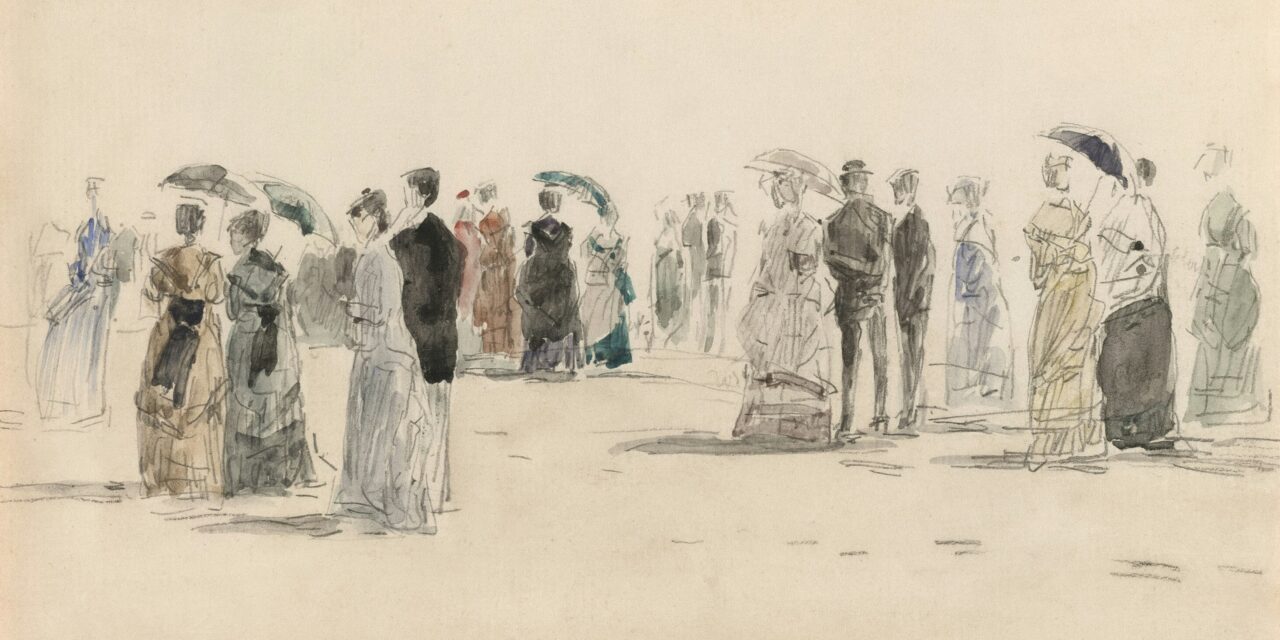
Eugène Boudin was born on July 12, 1824, in Honfleur, a picturesque port town in Normandy, France. His early life was steeped in the maritime culture of the region, as his father was a shipowner and his mother a seamstress. This environment fostered a deep appreciation for the sea and its ever-changing moods, which would later become a hallmark of Boudin’s artistic oeuvre. From a young age, he exhibited a keen interest in drawing, often sketching the boats and landscapes that surrounded him. His artistic inclinations were nurtured by his family, who encouraged his creative pursuits despite the practical expectations of a career in commerce.
Boudin’s formal education in art began when he moved to Le Havre at the age of 16. There, he worked as an assistant to a local painter, which provided him with invaluable experience in the techniques of oil painting and the nuances of colour. His exposure to the works of established artists, particularly those of the Barbizon School, further shaped his artistic vision. Boudin’s early studies were marked by a fascination with light and atmosphere, elements that would later define his style. He was particularly drawn to plein air painting, a technique that involved working outdoors to capture the natural world directly. This approach would become a defining characteristic of his work and set the stage for his future contributions to the Impressionist movement.
Eugène Boudin, renowned for his mastery of capturing the ephemeral qualities of light and atmosphere in his landscapes, has influenced countless artists throughout the years. For those interested in exploring the techniques that can enhance one’s artistic expression, a related article on screen printing techniques can be found at this link. This article delves into the intricacies of screen printing, offering insights that may inspire contemporary artists to experiment with new methods while reflecting on the legacy of pioneers like Boudin.
Influence of the Impressionist Movement
The Impressionist movement emerged in the late 19th century as a radical departure from traditional artistic conventions. Boudin, often regarded as a precursor to Impressionism, played a pivotal role in its development. His innovative use of colour and light laid the groundwork for many of the techniques that would later be embraced by artists such as Claude Monet and Pierre-Auguste Renoir. Boudin’s ability to capture fleeting moments in time through his brushwork and palette was revolutionary, allowing him to convey the essence of a scene rather than merely its details.
Boudin’s work was characterised by a vibrant colour palette and an emphasis on the effects of natural light. He often painted en plein air, which allowed him to observe and depict the changing qualities of light throughout the day. This practice not only influenced his own artistic style but also inspired his contemporaries. Boudin’s commitment to capturing the ephemeral beauty of nature resonated with other artists who sought to break free from the constraints of academic painting. His contributions to the Impressionist movement were not merely technical; they also encompassed a philosophical shift towards valuing personal expression and subjective experience in art.
Travels and Inspiration
Boudin’s artistic journey was marked by extensive travels throughout France and beyond, which enriched his understanding of diverse landscapes and cultures. His frequent visits to coastal towns such as Deauville and Trouville provided him with an abundance of inspiration, as he sought to capture the dynamic interplay between land and sea. The changing tides, shifting clouds, and vibrant skies became central themes in his work, reflecting his deep connection to the natural world.
In addition to his explorations within France, Boudin ventured further afield, travelling to Belgium and even as far as Italy. These journeys exposed him to different artistic traditions and styles, broadening his perspective and influencing his approach to painting. The Italian landscapes, with their dramatic vistas and rich colours, left a lasting impression on Boudin, prompting him to experiment with new techniques and compositions. His travels not only enriched his artistic vocabulary but also allowed him to forge connections with other artists, further solidifying his place within the evolving art scene of the time.
The Sea and Sky: Boudin’s Signature Subjects
The sea and sky emerged as Boudin’s signature subjects, reflecting both his personal experiences and his artistic vision. His fascination with maritime scenes stemmed from his upbringing in Honfleur, where he was surrounded by boats and fishermen. Boudin’s depictions of coastal life are imbued with a sense of immediacy and vitality, capturing the essence of the moment with remarkable precision. His ability to convey the movement of water and the play of light on its surface is particularly noteworthy; he often employed quick brushstrokes to evoke the fluidity of waves and the shimmering reflections created by sunlight.
In addition to maritime scenes, Boudin’s skies are equally captivating. He had an exceptional talent for rendering clouds and atmospheric conditions, often portraying them in various states—from serene blue expanses to tumultuous stormy skies. His keen observation of nature allowed him to depict not only the physical characteristics of these elements but also their emotional resonance. The interplay between sea and sky in Boudin’s work creates a harmonious balance that invites viewers into a world where nature reigns supreme. This duality became a defining feature of his artistic identity, setting him apart from many of his contemporaries.
Eugène Boudin, often celebrated as a pioneer of plein air painting, played a significant role in the development of Impressionism, influencing many artists who followed him. His ability to capture the fleeting effects of light and atmosphere is beautifully explored in a related article that delves into the broader context of colour expression in art. For those interested in understanding how Boudin’s techniques resonate with contemporary practices, this article offers valuable insights into the evolution of artistic expression. You can read more about it here.
Recognition and Success
Despite facing initial challenges in gaining recognition for his work, Boudin eventually achieved considerable success during his lifetime. His participation in various exhibitions, including the Salon de Paris, helped elevate his profile within the art community. Critics began to take notice of his innovative approach to light and colour, praising his ability to capture the essence of nature with remarkable sensitivity. As he gained recognition, Boudin became increasingly involved in the burgeoning Impressionist movement, exhibiting alongside prominent figures such as Monet and Degas.
Boudin’s success was not limited to France; he garnered international acclaim for his work as well. His paintings were exhibited in galleries across Europe and even reached audiences in America. The growing interest in Impressionism during the late 19th century further propelled Boudin into the spotlight, solidifying his status as one of the leading figures in this transformative movement. His ability to connect with viewers through his evocative depictions of nature resonated deeply, ensuring that his legacy would endure long after his passing.
Eugène Boudin, often celebrated as a pioneer of plein air painting, had a profound influence on the Impressionist movement and the works of artists such as Claude Monet. His ability to capture the ephemeral qualities of light and atmosphere can be further appreciated when exploring the techniques employed by his contemporaries. For instance, an insightful article on the painting “Mont Sainte-Victoire” by Paul Cézanne delves into the innovative approaches that shaped the landscape genre during that era. To learn more about this fascinating connection, you can read the article here.
Legacy and Influence
Eugène Boudin’s legacy is profound, extending far beyond his own body of work. As one of the earliest proponents of plein air painting, he laid the groundwork for future generations of artists who sought to capture the beauty of nature directly from observation. His innovative techniques influenced not only his contemporaries but also subsequent movements such as Post-Impressionism and Fauvism. Artists like Vincent van Gogh and Henri Matisse drew inspiration from Boudin’s vibrant use of colour and expressive brushwork, incorporating these elements into their own distinctive styles.
Moreover, Boudin’s emphasis on personal expression and subjective experience paved the way for modern art movements that prioritised individual interpretation over traditional representation. His ability to convey emotion through landscape painting resonated with artists seeking to explore new avenues of creativity. Today, Boudin is celebrated not only for his contributions to Impressionism but also for his role in shaping the trajectory of modern art as a whole.
Personal Life and Relationships
Boudin’s personal life was marked by both triumphs and challenges that shaped his character and artistic vision. He experienced periods of financial instability early in his career, which often led him to question his path as an artist. However, he found solace in his relationships with fellow artists who shared similar struggles and aspirations. His friendships with figures such as Claude Monet were particularly significant; they provided mutual support and encouragement during times of uncertainty.
Boudin’s romantic life was also complex. He had several relationships throughout his life, but it was his partnership with fellow artist Berthe Morisot that stands out most prominently. Their connection was both personal and professional; they shared a deep appreciation for each other’s work and often exchanged ideas about their artistic practices. This relationship not only enriched Boudin’s life but also contributed to the broader dialogue within the Impressionist movement regarding gender roles and artistic collaboration.
Boudin’s Impact on Art History
Eugène Boudin’s impact on art history is undeniable; he occupies a crucial position as a bridge between traditional landscape painting and the revolutionary ideas that characterised Impressionism. His pioneering techniques in capturing light and atmosphere laid the foundation for many artists who followed in his footsteps. By embracing plein air painting and prioritising direct observation of nature, Boudin challenged established norms and opened new avenues for artistic expression.
Furthermore, Boudin’s influence extends beyond technical innovation; he also contributed significantly to shifting perceptions about landscape painting itself. By elevating everyday scenes—such as coastal views or bustling harbours—to subjects worthy of serious artistic consideration, he helped redefine what constituted fine art during his time. Today, Boudin is celebrated not only for his own remarkable body of work but also for his enduring legacy as an artist who championed innovation, personal expression, and a profound connection to nature within the realm of art history.
FAQs
Who was Eugène Boudin?
Eugène Boudin was a French landscape painter and a pivotal figure in the development of Impressionism. He was known for his seascapes and beach scenes, and was a mentor to many of the Impressionist painters.
What were some key moments in Eugène Boudin’s life?
Boudin was born in Honfleur, France in 1824. He began his career as a stationery and framing shop owner, but later devoted himself to painting. He travelled extensively throughout Europe, painting landscapes and seascapes. He also exhibited at the Paris Salon and gained recognition for his work.
What was Eugène Boudin’s artistic style?
Boudin’s artistic style was characterized by his use of light and colour to capture the effects of the changing weather and atmosphere on the sea and sky. He was known for his loose brushwork and ability to convey the transient nature of light and movement.
What was Eugène Boudin’s influence on the Impressionist movement?
Boudin’s work had a significant influence on the Impressionist movement. He was a mentor to many of the young artists who would later become prominent Impressionists, including Claude Monet. Boudin’s emphasis on capturing the effects of light and atmosphere on the landscape was a key aspect of Impressionist painting.
What is Eugène Boudin’s legacy?
Eugène Boudin is remembered as a pioneering figure in the development of Impressionism. His work continues to be celebrated for its innovative use of light and colour, and its influence on subsequent generations of artists. Boudin’s paintings are held in major museums and collections around the world.