Early Years and a Forged Path
James Abbott McNeill Whistler’s life began under the unlikely skies of Lowell, Massachusetts, on 10th July 1834. His father, George Washington Whistler, was a civil engineer whose career would shape young James’s formative years significantly. The family’s move to St. Petersburg, Russia, in 1843, following George’s appointment to oversee the construction of the Moscow-Saint Petersburg Railway, immersed Whistler in a new cultural landscape. This period, from the age of nine to fifteen, exposed him to European art and architecture, a stark contrast to his American upbringing.
A European Childhood
Life in St. Petersburg was one of relative privilege, with access to the Hermitage Museum and the Imperial Academy of Arts. Whistler, demonstrating an early aptitude for drawing, received private art lessons at the latter, an experience that undoubtedly sowed the seeds of his future artistic ambitions. He travelled with his family, experiencing glimpses of England and France, countries that would later become central to his artistic development. This transnational childhood, a blend of American pragmatism and European cultural immersion, laid a complex foundation for his identity and artistic vision.
Engineering Dreams and Artistic Reality
The tragic death of his father in 1849, contracting cholera in Russia, precipitated the family’s return to the United States. Whistler’s mother, Anna Matilda Whistler (the subject of his most famous portrait), sought to direct her son towards a more stable, respectable profession. Following in his father’s footsteps, he enrolled at the United States Military Academy at West Point in 1851. However, Whistler proved an indifferent, even recalcitrant, cadet. His academic performance was poor, particularly in chemistry, and he struggled with military discipline. His artistic inclination, however, remained strong; he excelled in drawing and cartography, disciplines he found engaging. Ultimately, his insubordination and academic shortcomings led to his dismissal from West Point in 1854. This release from a predetermined career path, while initially a disappointment to his family, was a crucial turning point, freeing him to pursue his genuine vocation.
James McNeill Whistler, renowned for his innovative approach to colour and composition, has often been compared to other influential artists of his time. A fascinating exploration of the work of Ernst Ludwig Kirchner, another pivotal figure in the art world, can be found in the article titled “An Introduction to the Painting Five Women on the Street (1913) by Ernst Ludwig Kirchner.” This piece delves into Kirchner’s unique style and the societal themes he portrayed, offering a compelling contrast to Whistler’s own artistic journey. For more insights, you can read the article here.
Parisian Bohemia and Artistic Apprenticeship
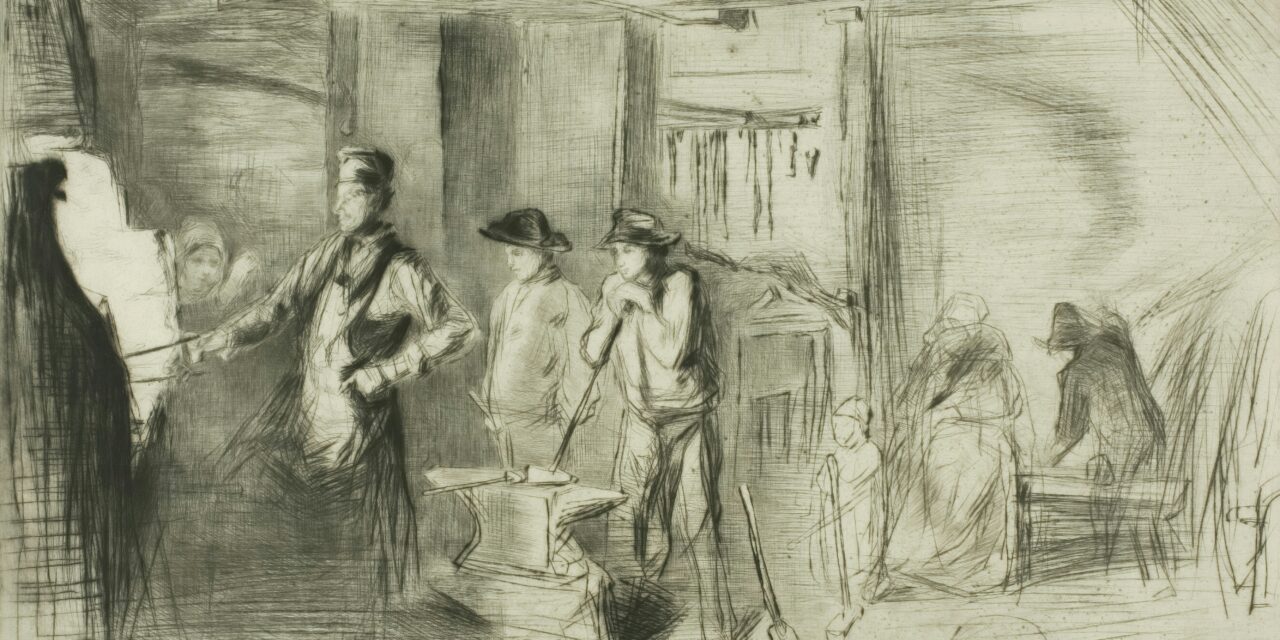
After a brief, unfulfilling stint as a draughtsman for the U.S. Coast Survey – where he learned etching techniques that would prove invaluable – Whistler, with characteristic resolve, convinced his mother to allow him to pursue art in Europe. In 1855, at the age of 21, he embarked on a journey to Paris, a vibrant epicentre of the art world. This period marked his serious artistic apprenticeship and immersion in bohemian life.
Atelier Gleizes and the École Impériale
Upon arrival in Paris, Whistler enrolled at the École Impériale et Spéciale de Dessin, and later, more significantly, in theatelier of Charles Gleyre. Gleyre’s studio, while traditional in its teaching, provided a foundational understanding of academic drawing and composition. Whistler, however, was not content with conventional instruction. His independent spirit and burgeoning interest in realism and modernity led him to frequent the Louvre, studying old masters, and to sketch tirelessly from life. He absorbed the lessons of the past while simultaneously seeking new approaches.
Friendships and Influences
Paris was a melting pot of artistic experimentation, and Whistler quickly aligned himself with a progressive circle of artists. He forged friendships with Henri Fantin-Latour, Alphonse Legros, and Édouard Manet. These connections exposed him to the emerging avant-garde and the realist movement, exemplified by Gustave Courbet. Whistler admired Courbet’s rejection of academic idealism and his commitment to depicting everyday life. While never a direct follower, Courbet’s influence can be seen in Whistler’s early, unsentimental genre scenes and portraits. He also travelled to Italy and the Netherlands, further broadening his artistic horizons and deepening his appreciation for the technical mastery of artists like Rembrandt and Velázquez, whose use of tone and atmosphere would profoundly impact his later work.
The Move to London
Despite his growing connections in Paris, Whistler found himself drawn to London. The city offered a thriving art market, a different artistic sensibility, and the potential for greater recognition. In 1859, he made the decisive move across the Channel, establishing himself in Chelsea, a district increasingly favoured by artists. This shift marked a significant transition, as he began to carve out his distinct identity within the British art scene, though his French influences remained evident.
London’s Social Landscape and Artistic Innovation
Whistler’s arrival in London coincided with a period of significant social and artistic change. He quickly established himself not only as an innovative artist but also as a distinctive personality within the city’s intellectual and social circles. His flamboyant character, wit, and often abrasive manner would become as renowned as his art.
The Thames Series and Japanese Influence
During his early years in London, Whistler focused on subjects that resonated with his realist leanings. His series of etchings and paintings depicting the River Thames, particularly the grimy industrial areas and bustling wharves, captured the contemporary urban landscape with a poetic sensibility. These works, such as “Wapping” (1860-64), demonstrated his meticulous observation and his burgeoning interest in atmosphere and mood. It was also during this period that Whistler encountered Japanese prints, particularly ukiyo-e woodcuts, which arrived in Europe as packing material for imported goods. This encounter was transformative. He was captivated by their flattened perspective, asymmetrical compositions, bold outlines, and sophisticated use of negative space. The influence of Japanese art would become a cornerstone of his aesthetic, leading him to simplify forms, experiment with unconventional cropping, and arrange elements with a newfound emphasis on decorative harmony.
Exploring the “Symphony” and “Nocturne”
Whistler’s commitment to the aesthetic movement, summarised by the credo “art for art’s sake,” became increasingly pronounced. He rejected the prevailing Victorian notion that art should serve a moral or narrative purpose. Instead, he championed the idea that a painting’s value lay in its formal qualities – its lines, colours, and forms – much like music. This led him to give his works evocative, musical titles such as “Symphony in White, No. 1: The White Girl” (1862) and “Nocturne in Blue and Gold: Old Battersea Bridge” (c. 1872-77). These titles underscored his intention to create visual harmonies rather than historical or social commentaries. The “Nocturnes,” in particular, were radical in their abstraction. They depicted twilight or nighttime scenes of the Thames and surrounding areas, rendered with a limited palette and a focus on mood and ephemeral light effects. Whistler sought to capture the “impressions” of a scene rather than its literal representation, effectively anticipating aspects of Impressionism while maintaining a distinct personal vision.
Whistler’s Portraits: Beyond Likeness
While his Nocturnes pushed the boundaries of representation, Whistler also established himself as a prominent portrait painter. His portraits, though often featuring society figures, were not merely literal likenesses but carefully constructed studies in tone, composition, and character. His most famous work, “Arrangement in Grey and Black No. 1” (1871), commonly known as “Whistler’s Mother,” epitomises this approach. It is a nuanced study of form and colour, a poignant depiction of his mother, but also an exploration of universal human experience. His portraits often featured individuals in carefully arranged, often domestic, settings, with a subdued palette that drew attention to the sitter’s presence and the subtle interplay of light and shadow.
The Ruskin Trial and its Aftermath
Whistler’s unwavering belief in “art for art’s sake” and his often-provocative artistic choices inevitably brought him into conflict with the conservative art establishment and outspoken critics of the era. The most notorious of these confrontations was his libel suit against the eminent art critic John Ruskin in 1878.
Ruskin’s Condemnation
The catalyst for the trial was Ruskin’s scathing review of Whistler’s art, particularly his “Nocturne in Black and Gold – The Falling Rocket” (c. 1875). In his publication Fors Clavigera, Ruskin declaimed, “I have seen, and heard, much of Cockney impudence before now; but never expected to hear a coxcomb ask two hundred guineas for flinging a pot of paint in the public’s face.” This ferocious critique was not merely a dismissal of the painting but a personal attack on Whistler’s artistic integrity and competence. Ruskin, as a leading proponent of moral art and a champion of Pre-Raphaelite ideals, saw Whistler’s abstract, aesthetic approach as a dereliction of artistic duty and a sign of cultural decay.
The Courtroom Drama
Whistler, known for his combative nature and keen sense of personal honour, could not let such an insult pass unchallenged. He sued Ruskin for libel, seeking damages for the harm done to his reputation. The trial, held in November 1878, became a public spectacle, encapsulating the clash between entrenched Victorian artistic values and the burgeoning aesthetic movement. Whistler defended his art with eloquent and often witty arguments, famously asserting that the “Nocturne” was “a representation of fireworks at Cremorne,” but that its artistic value lay in its arrangement of colour and light, not in its literal depiction. Despite his persuasive defence, Whistler faced formidable legal and cultural opposition. Ruskin, due to ill health, did not appear in court, but his lawyers forcefully argued his position.
A Pyrrhic Victory
The verdict was a qualified victory for Whistler; the jury found in his favour but awarded him only a farthing in damages, effectively a moral victory with little financial compensation. The legal costs of the trial, however, proved ruinous. Whistler was declared bankrupt in 1879, a devastating blow to his financial stability and personal pride. He was forced to sell his house and many of his possessions. Despite the financial hardship, the trial did serve to elevate Whistler’s profile, making him a household name, though often associated with controversy rather than solely his art. The trial ultimately highlighted the growing schism between traditional, narrative-driven art and the modern approach championed by Whistler, paving the way for future artistic innovations.
James McNeill Whistler’s artistic journey is not only marked by his innovative techniques but also by his profound understanding of colour and its emotional impact. His work often exemplifies the principles of colour psychology, which explores how different hues can evoke various feelings and responses in viewers. For those interested in delving deeper into this fascinating subject, a related article on the influence of colours in art can be found here: colour psychology in art. This exploration complements Whistler’s legacy, highlighting how his mastery of colour contributed to the emotional depth of his paintings.
Later Years and Enduring Legacy
The bankruptcy following the Ruskin trial marked a significant juncture in Whistler’s life, but it did not diminish his artistic output or his resolve. He continued to work, travel, and exhibit, solidifying his reputation as a significant figure in modern art.
Venice and the New Etchings
Facing dire financial circumstances, Whistler accepted a commission from the Fine Art Society to produce a set of etchings in Venice within three months. This period, from 1879 to 1880, proved to be restorative both personally and artistically. He produced a prolific number of etchings, known as the “Venice Set,” which are considered masterpieces of the medium. These works, with their delicate lines, atmospheric effects, and masterful use of negative space, captured the unique light and labyrinthine charm of Venice. They were highly successful, both critically and commercially, and helped to restore his financial standing and artistic reputation.
Return to London and Further Recognition
Upon his return to London, Whistler continued to exhibit his work, often designing the entire exhibition space himself, from the wall colours to the frame designs, creating a total aesthetic experience. He was a meticulous perfectionist, demanding high standards from himself and others. He continued to paint portraits, exploring new patrons and evolving his stylistic approach. In the 1880s, he developed a series of pastel portraits and small oils that further refined his sense of colour and composition. His fame spread beyond England, with exhibitions in Paris and New York. He continued to be a vocal presence in the art world, lecturing on art theory and engaging in public debates.
Public Recognition and The Gentle Art
Despite his often-contentious relationships, Whistler gained increasing recognition and respect as a leading artist. He was elected a member of the Royal Society of British Artists in 1884, and later served as its president, though his tenure was brief and marked by his characteristic refusal to compromise. His written works, particularly The Ten O’Clock Lecture (1885), articulated his aesthetic philosophy of “art for art’s sake” with wit and eloquence. He later compiled his essays, correspondences, and the transcripts from the Ruskin trial into The Gentle Art of Making Enemies (1890), a highly individual and stylistically distinctive work that revealed his acerbic wit and unwavering self-belief. This book became a classic of artistic polemic, further cementing his image as an intellectual and a formidable personality.
Final Years and Legacy
Whistler spent his final years between London and Paris, continuing to paint, lecture, and engage with the art world. He died in London on 17th July 1903, at the age of 69. His legacy is multifaceted. He was a pioneering figure in the Aesthetic Movement, a champion of “art for art’s sake,” and a significant precursor to modern art. His sophisticated use of colour and tone, his innovative compositions influenced by Japanese prints, and his exploration of atmosphere and suggestion laid groundwork for future generations of artists. He broke away from academic traditions, demonstrating that art could transcend narrative and serve as an end in itself. While initially controversial, his work is now widely celebrated for its elegance, originality, and profound impact on the trajectory of Western art, ensuring his place as one of the most influential artists of the late 19th century.
FAQs
Who was James McNeill Whistler?
James McNeill Whistler was an American-born artist, active during the 19th century, who is best known for his contributions to the art world as a painter and printmaker.
What are some of James McNeill Whistler’s most famous works?
Some of Whistler’s most famous works include “Arrangement in Grey and Black No. 1” (also known as “Whistler’s Mother”), “Nocturne in Black and Gold: The Falling Rocket”, and “Symphony in White, No. 1: The White Girl”.
What was James McNeill Whistler’s artistic style?
Whistler was associated with the Aesthetic movement and is known for his innovative approach to composition, use of color, and his focus on capturing the essence of his subjects rather than their literal representation.
Where did James McNeill Whistler live and work during his career?
Whistler lived and worked in various cities throughout his career, including Paris, London, and Venice. He was known for his involvement in the art scenes of these cities and for his interactions with other prominent artists of the time.
What is James McNeill Whistler’s legacy in the art world?
Whistler’s legacy in the art world includes his influence on the development of modern art, particularly in his emphasis on the importance of the artist’s individual vision and his rejection of traditional artistic conventions. His work continues to be celebrated and studied by art enthusiasts and scholars worldwide.