The ethereal glow of the Symbolist movement, its mystical undercurrents and spiritual quests, often conjure images of Gauguin’s Tahitian dreamscapes or Redon’s enigmatic eyes. Yet, within this vibrant tapestry of late 19th-century art, a figure less frequently lauded, but no less profound, emerges: Johannes Theodorus “Jan” Verkade. A Dutchman by birth, a French Nabis by inclination, and ultimately a Benedictine monk by spiritual conviction, Verkade’s journey through art and faith offers a unique lens through which to explore the profound interplay between artistic expression and a yearning for the absolute. His oeuvre, though sometimes overshadowed by his more famous contemporaries, is a testament to a deeply introspective spirit, evolving from the secular pursuit of beauty to a sacred dedication to God.
Jan Verkade’s artistic beginnings, though seemingly conventional, harboured a restless spirit destined for far greater explorations. Born in 1868 into a prosperous Amsterdam family, his early life was marked by a comfortable upbringing and a nascent interest in art. This initial foray into the visual arts was not without its struggles, reflecting a common narrative of young artists grappling with the prevailing academic strictures of their time.
Early Influences and the Lure of Paris
Verkade initially trained at the Rijksakademie van Beeldende Kunsten in Amsterdam, a prestigious institution but one steeped in conservative artistic principles. The academy, with its emphasis on classical draughtsmanship and historical painting, soon proved to be a restrictive environment for the budding artist. He found himself increasingly drawn to the burgeoning avant-garde movements swirling across Europe, particularly those emanating from Paris. The vibrant energy and revolutionary ideas of the Impressionists and Post-Impressionists captivated him, suggesting a path beyond the academic confines.
It was during this period that Verkade encountered like-minded individuals within the Dutch art scene who shared his dissatisfaction with academic norms. He was particularly drawn to the innovative approaches of artists such as Vincent van Gogh, whose expressive use of colour and brushstroke offered a radical departure from traditional representation. This exposure, coupled with a growing sense of artistic stagnation in Amsterdam, solidified his resolve to seek out the epicentre of artistic innovation. The move to Paris, then, was not merely a change of address, but a pilgrimage – a conscious step towards a new artistic vernacular and a spiritual awakening.
Joining the Nabis: A Brotherhood of Idealists
Verkade arrived in Paris in 1890, a pivotal moment in his artistic development. The city, a crucible of artistic experimentation, quickly introduced him to the avant-garde circles he had so keenly sought. It was here, through the introductions of his Dutch compatriot Meyer de Haan, that Verkade became acquainted with the influential group of artists known as the Nabis. The Nabis, meaning “prophets” in Hebrew, were a brotherhood of young artists who, under the charismatic leadership of Paul Sérusier and Maurice Denis, sought to infuse art with spiritual meaning and symbolic resonance.
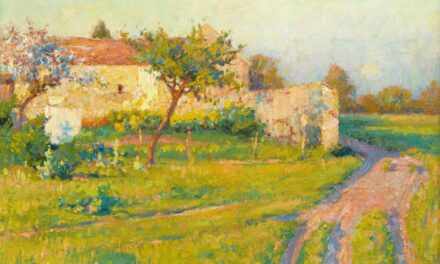
Verkade’s integration into this group was swift and profound. He found in the Nabis a shared intellectual and spiritual curiosity that resonated deeply with his own emerging sensibilities. Their embrace of synthétisme, a style advocating for the synthesis of observation, emotion, and aesthetic principles, offered a liberating alternative to naturalistic depiction. This approach, heavily influenced by Paul Gauguin’s teachings from Pont-Aven, encouraged artists to simplify forms, use bold, unmixed colours, and imbue their works with symbolic weight. Verkade’s initial Nabis works, such as “The Garden of the Hesperides” (c. 1891), exhibit this distinctive blend of simplified forms, flattened planes, and an evocative use of colour, leaning towards a dreamlike, almost mystical quality. He quickly adopted their innovative techniques, including the use of strong outlines, flat areas of colour, and a rejection of academic illusionism, all in pursuit of a more expressive and spiritually charged art.
For those interested in exploring the emotional depth and advanced techniques in portraiture, a related article titled “Expressive Portraits: Capturing Emotion in Advanced Techniques” provides valuable insights into the methods artists use to convey feelings through their work. This article complements the exploration of Jan Verkade’s artistry, as both delve into the intricate relationship between emotion and artistic expression. To read more about these advanced techniques, visit this link.
The Search for the Sacred: Embracing Mysticism and Conversion
Verkade’s journey with the Nabis was not merely an exploration of new artistic techniques; it was inextricably linked to a profound spiritual quest. The group’s emphasis on the artist as a high priest, interpreting and revealing spiritual truths through their work, provided fertile ground for Verkade’s already introspective nature. This period marked a significant turning point, one that would ultimately lead him away from the secular art world and into the embrace of monastic life.
Pont-Aven and the Influence of Gauguin
The Nabis’ frequent sojourns to Pont-Aven in Brittany proved to be particularly influential for Verkade. It was there that he encountered Paul Gauguin firsthand, a pivotal figure whose philosophical and artistic ideas profoundly impacted the young Dutch artist. Gauguin’s emphasis on subjective experience, his rejection of Western materialism, and his pursuit of a more “primitive” and spiritual art deeply resonated with Verkade’s evolving worldview. The rugged landscape and strong Catholic traditions of Brittany further contributed to this spiritual awakening, offering a stark contrast to the secular sophistication of Paris.
Under Gauguin’s tutelage, Verkade honed his use of vibrant, non-naturalistic colours and simplified forms, techniques that he would later adapt to his own spiritual themes. Gauguin’s notion of l’âme primitive — the primitive soul — resonated deeply with Verkade’s yearning for a more authentic and less superficial existence. He began to see art not just as a means of depicting the world, but as a vehicle for expressing profound spiritual truths, a medium through which to touch the divine. This period saw the emergence of works where religious symbolism began to subtly intertwine with his landscapes and portraits, betraying a growing spiritual undercurrent that would soon define his artistic and personal trajectory.
The Path to Benedictine Monasticism
Verkade’s spiritual exploration was not confined to artistic expression. His deep immersion in Symbolist philosophy and the Nabis’ mystical leanings led him to seriously contemplate his spiritual path. The influence of Maurice Denis, a devout Catholic, and the writings of figures like Joris-Karl Huysmans further intensified his spiritual yearning. He immersed himself in Catholic literature and began to frequent churches in his search for meaning beyond the material.
This intense period of introspection culminated in a profound decision: his conversion to Catholicism in 1892. This was no mere intellectual exercise; it was a soul-stirring transformation that irrevocably altered the course of his life. Shortly after his conversion, in 1894, he entered the Benedictine monastery of Beuron in Germany, taking the name Willibrord. This decision, seemingly abrupt to many of his artistic contemporaries, was in fact the culmination of years of spiritual searching. His entry into monastic life was not a rejection of art, but rather a re-contextualization of it. For Verkade, art and faith were not separate entities, but intertwined paths towards revealing the divine.
Fr. Willibrord Verkade: Art in the Service of God
Jan Verkade’s transformation into Father Willibrord Verkade marked a significant shift in his artistic and personal trajectory. From a secular artist exploring the boundaries of modern art, he became a monastic artist dedicated to the service of God and the renewal of Christian art. His new environment and spiritual convictions deeply influenced his artistic output, leading him to develop a distinctive style that merged Nabis aesthetics with the ancient traditions of Christian art.
The Beuron Art School and Its Principles
The Benedictine Abbey of Beuron was not merely a place of spiritual retreat; it was also a burgeoning centre for artistic innovation within a monastic context. Under the leadership of Desiderius Lenz, the Beuron Art School, also known as the Beuron school of sacred art, sought to revive Christian art by drawing inspiration from ancient Egyptian, Byzantine, and early Christian art forms. They believed that art should serve a didactic and spiritual purpose, rather than being an expression of individualistic emotion. The Beuron style emphasised geometric precision, symbolic representation, and a sense of timelessness, eschewing the naturalism and individualism prevalent in contemporary art.
Verkade, with his Nabis background and a deep understanding of symbolic representation, was uniquely positioned to contribute to this artistic movement. He found in Beuron an ideological framework that resonated with his own conviction that art should transcend mere aesthetic pleasure and aspire to spiritual truth. He enthusiastically embraced Beuron’s principles, seeing them as a means to create sacred art that was both profound and aesthetically rigorous. His work within the Beuron school demonstrates a synthesis of his earlier Nabis aesthetic – particularly the use of flat areas of colour and strong outlines – with the school’s strict adherence to geometric forms and symbolic iconography.
Major Works and Artistic Contributions
During his time at Beuron, Fr. Willibrord Verkade became a key figure in the school, contributing significantly to its artistic output and intellectual discourse. He worked on numerous commissions, often collaborating with other monks, creating frescoes, altar pieces, and stained glass windows that adorned churches and monasteries throughout Europe. His most notable works from this period include the frescoes in the refectory of the Abbey of Monte Cassino in Italy (though tragically destroyed during World War II) and his contributions to the decoration of the Abbey of Beuron itself.
His art from this period is characterised by a serene monumentality, a clarity of form, and an evocative use of colour that, while stylised, conveys a deep spiritual resonance. He skillfully integrated biblical narratives and hagiographies into the Beuron style, creating works that were both aesthetically powerful and doctrinally sound. Verkade’s unique contribution lay in his ability to infuse the traditional and often austere Beuron aesthetic with a subtle hint of the expressive power he had learned from his Nabis years, lending his religious works a particular luminosity and emotive depth. He also published extensively, writing about the principles of the Beuron school and advocating for a renewed sacred art that was both traditional and modern.
The Enduring Legacy of Jan Verkade
The life and art of Jan Verkade, or rather, Father Willibrord Verkade, offer a compelling narrative of spiritual and artistic evolution. His journey from a promising Dutch painter to a French Symbolist and finally to a Benedictine monk leaves behind a legacy that continues to resonate within both art history and the broader understanding of spiritual art.
Reconciling Art and Spirituality
Verkade’s most significant legacy lies in his successful reconciliation of the avant-garde artistic sensibilities of his youth with the profound spiritual convictions of his later life. He demonstrated that art, even modern art, could serve as a powerful vehicle for religious expression without sacrificing aesthetic integrity. His work, particularly from his Beuron period, stands as a testament to the idea that faith can inspire artistic innovation and that artistic talent can be consecrated to the divine. He bridged the perceived divide between the secular and the sacred, showing that an artist’s pursuit of beauty can ultimately lead to a deeper understanding of God.
His artistic odyssey presents a unique perspective on the Symbolist movement itself. While many Symbolists explored spiritual themes, Verkade took that exploration to its ultimate conclusion, embodying the very ideals of spiritual transcendence that many of his contemporaries only alluded to in their art. His life became a living embodiment of the Symbolist ambition to infuse art with a sense of the sacred and the transcendent.
A Rediscovery of a Master
For much of the 20th century, Jan Verkade’s work was less widely known compared to his more secular Nabis counterparts. However, there has been a growing scholarly and public interest in his oeuvre in recent decades. Exhibitions and publications have brought his unique artistic journey to a wider audience, prompting a re-evaluation of his place within modern art history. His ability to synthesize diverse influences, from the vibrant colours of Gauguin to the rigid geometries of Beuron, makes his work particularly engaging to contemporary viewers.
Art historians are increasingly recognising the depth and complexity of his artistic vision, understanding that his monastic life was not a withdrawal from art, but a transformation of it. He is now celebrated not only for his formal innovations but also for the profound spiritual integrity that permeates his entire body of work. Verkade’s art serves as a powerful reminder that the pursuit of beauty and the search for truth can indeed be one and the same journey, a path illuminated by both paint and prayer.
For those interested in exploring the broader context of contemporary art spaces, a related article on the Nasher Sculpture Center in Dallas provides valuable insights into how such institutions contribute to the appreciation of artists like Jan Verkade. This introduction highlights the significance of sculpture in the modern art landscape and complements the understanding of Verkade’s unique contributions to the art world.
“The Difficult Road”: Verkade’s Enduring Philosophical Impact
Beyond his artistic output, Jan Verkade’s reflections on his journey, particularly his illuminating autobiography “Die Unruhe zu Gott” (The Unrest towards God), later translated as “The Difficult Road,” offer profound philosophical insights into the relationship between artistic creation, spiritual yearning, and the human condition.
The Artist as Seeker
Verkade’s life story, as meticulously documented in “The Difficult Road,” positions the artist not merely as a creator of images, but as an existential seeker. He articulates the inherent restlessness of the human spirit, a “unrest towards God,” that drives individuals to search for meaning beyond the superficial. For Verkade, this search manifested initially in his artistic explorations – the rejection of academic norms, the embrace of Symbolism, and the pursuit of a deeper, more evocative visual language. He saw his artistic journey as an innate human striving for the absolute, a premonition of his eventual spiritual conversion. His autobiography allows us to understand his artistic choices as deeply personal, often existential responses to the dilemmas of his time, reflecting a broader Symbolist preoccupation with spiritual malaise and the desire for transcendence.
He eloquently describes how the superficiality of the fin-de-siècle art world ultimately left him unfulfilled, prompting a deeper dive into spiritual inquiry. This narrative resonates with many who struggle to find meaning in a secularised world, highlighting the enduring human need for purpose and connection. Verkade’s philosophical impact lies in showcasing how an authentic artistic pursuit can lead one to profound spiritual truths, framing the artist as a solitary journeyer on a path of self-discovery and ultimate cosmic connection.
Influence on Subsequent Generations of Religious Artists
Verkade’s synthesis of modern artistic techniques with traditional religious iconography, coupled with his insightful writings, has had a quiet yet significant influence on subsequent generations of religious artists and thinkers. He demonstrated that one need not abandon artistic innovation to create meaningful sacred art. His example provided a blueprint for how artists could engage with contemporary artistic movements while remaining faithful to deeply held spiritual beliefs.
His writings, particularly “The Difficult Road,” have become important texts for understanding the spiritual dimensions of early modern art and the broader Symbolist movement. They offer a rare first-person account of an artist’s profound spiritual transformation, providing valuable insights into the motivations and philosophies of artists navigating a period of immense change. Verkade’s legacy extends beyond the canvas; it encompasses his lived experience and his reflective articulation of that experience, urging both artists and spiritual seekers to embark on their own “difficult roads” in pursuit of deeper truths. His life serves as a powerful testament to the idea that true artistic and spiritual fulfillment often lies in embracing the journey of discovery, however challenging it may be.
FAQs
Who is Jan Verkade?
Jan Verkade was a Dutch painter, sculptor, and printmaker who was associated with the Symbolist movement in art. He was also a member of the artist collective known as the Nabis, which included prominent artists such as Pierre Bonnard and Edouard Vuillard.
What are some notable works by Jan Verkade?
Some of Jan Verkade’s notable works include “The Annunciation,” “The Visitation,” and “The Nativity.” He was known for his religious and mystical themes, as well as his use of bold colors and expressive brushwork.
What was Jan Verkade’s artistic style?
Jan Verkade’s artistic style was heavily influenced by the Symbolist movement, which sought to convey emotions and ideas through symbolic imagery. His work often featured dreamlike and spiritual themes, with an emphasis on capturing the inner world of the human psyche.
What was Jan Verkade’s role in the Nabis group?
Jan Verkade was one of the founding members of the Nabis, a group of avant-garde artists in Paris who sought to create art that was free from the constraints of traditional academic styles. He collaborated with other Nabis artists to create innovative and experimental works that pushed the boundaries of artistic expression.
What is Jan Verkade’s legacy in the art world?
Jan Verkade’s work has had a lasting impact on the art world, particularly within the Symbolist and Nabis movements. His bold use of color and expressive style continue to inspire artists today, and his contributions to the development of modern art are widely recognized and celebrated.