Winslow Homer (1836-1910) stands as a titan of American art, a painter whose visceral connection to the natural world and profound understanding of the human condition forged a unique and enduring legacy. From the turbulent battlefields of the Civil War to the crashing waves of the Atlantic, Homer’s oeuvre is a testament to his unwavering dedication to depicting life as he observed it, unfiltered and with an almost journalistic integrity. He was an artist who forged his own path, largely self-taught, and in doing so, created a distinctive visual language that resonates with timeless power, exploring themes of struggle, resilience, and the sublime beauty of nature.
The Formative Years: From Illustration to Independent Artist
Born in Boston, Massachusetts, in 1836, Winslow Homer’s early life was marked by a keen observational eye and a burgeoning talent for drawing. His family relocated to Cambridge when he was six, a period that instilled in him a lifelong love for the natural world. Unlike many of his contemporaries who sought formal academic training in Europe, Homer’s artistic education was largely forged through practical experience.
Early Career as a Commercial Illustrator
At 19, Homer began an apprenticeship with the Boston commercial lithographer, J. H. Bufford. This rigorous training in a commercial environment honed his draughtsmanship and instilled a strong work ethic. He spent two years at Bufford’s, developing a remarkable ability to capture dynamic scenes and translate them into print. This period, though not overtly artistic in the classical sense, provided him with invaluable skills in composition, line, and the art of storytelling through images – skills that would serve him throughout his painting career.
Freelance Work and the Lure of New York
In 1857, Homer turned freelance, initially creating illustrations for various Boston-based publications. However, the burgeoning publishing industry in New York City soon beckoned. In 1859, he moved to New York and began contributing to Harper’s Weekly, one of the most popular illustrated magazines of the era. His illustrations for Harper’s covered a wide range of subjects, from society scenes and fashion to political events and everyday life. This constant demand for new and engaging imagery further sharpened his observational skills and his ability to convey narrative through visual means. It also put him at the forefront of contemporary American life, allowing him to witness and document significant historical events.
Documenting the Civil War
The outbreak of the American Civil War in 1861 marked a pivotal moment in Homer’s career. Harper’s Weekly sent him to the front as an artist-correspondent, a role that brought him face-to-face with the grim realities of conflict. His illustrations from the war zone are not romanticised depictions of heroism but rather stark, honest portrayals of soldiers’ daily lives, their moments of anticipation, boredom, and fear. Works such as “Sharpshooter on Picket Duty” (1862) and “The Army of the Potomac – A Sharpshooter at Fenwick, VA.” (1862) reveal his remarkable ability to capture the psychological toll of war. These experiences would profoundly influence his later artistic themes, instilling a deep appreciation for human resilience and the stark beauty of struggle. It was also during this period that Homer began to experiment with oil painting, transitioning from the black-and-white world of illustration to the vibrant palette of fine art. His early oil paintings, such as “Prisoners from the Front” (1866) and “The Veteran in a New Field” (1865), are powerful statements on the immediate aftermath of the war, showcasing his burgeoning talent for evocative portraiture and narrative depth.
For those interested in exploring the artistic contributions of Winslow Homer, a related article that delves into the broader context of art appreciation is available at Art for All. This piece provides insights into how art can be accessible to everyone, highlighting the importance of understanding and engaging with various artists, including Homer, whose works resonate with themes of nature and human experience.
The American Scene and Early Masterpieces
Following the Civil War, Homer began to focus primarily on painting, turning his attention to the everyday lives of ordinary Americans and the burgeoning post-war landscape. His work from this period often explored themes of childhood, rural life, and the burgeoning industrialisation of the nation.
Celebrating Rural Life and Childhood
Homer’s paintings of children playing on farms, at school, or by the sea capture a sense of innocence and timeless joy. Works like “Snap the Whip” (1872) and “The School Room” (1871) are notable for their naturalism and their ability to convey the spirit of youthful exuberance and camaraderie. These are not sentimentalised images but rather authentic portrayals of childhood, revealing Homer’s keen eye for expressive gesture and nuanced emotion. He often depicted children engaged in simple, universal activities, reflecting a broader sense of an idyllic, agrarian America.
Social Observation and the African American Experience
Homer also courageously addressed social issues of his time, particularly the challenges faced by African Americans in the post-Civil War era. While some of his early illustrations can be seen as reflecting the racial biases of the period, his later paintings, such as “A Visit from the Old Mistress” (1876) and “The Cotton Pickers” (1876), offer more empathetic and nuanced portrayals. These works are significant for their directness and their willingness to depict the realities of Reconstruction, exploring themes of freedom, labour, and the complex relationships that continued to exist between former slaves and their previous owners. Homer’s approach was often one of quiet observation, allowing the viewer to interpret the subtle dynamics at play within his compositions.
Technical Development and the Appeal of Watercolour
During the 1870s, Homer further developed his mastery of watercolour, a medium he would elevate to an unprecedented level of artistic significance. His early watercolour experiments were often preparatory studies for oil paintings, but he soon recognised its potential for capturing fleeting moments and delicate atmospheric effects. Its portability and speed allowed him to work en plein air, directly engaging with nature. His watercolour landscapes from this period, particularly those depicting the Adirondack Mountains and the coast of Massachusetts, are characterised by their vibrant colours, fluid brushwork, and remarkable ability to depict light and shadow. He revolutionised the use of watercolour, moving it beyond a purely illustrative or amateur medium, demonstrating its capacity for profound artistic expression.
The English Sojourn and a Deeper Engagement with the Sea
In 1881, Homer embarked on a significant two-year sojourn to Cullercoats, a fishing village on the North East coast of England. This period proved to be transformative, solidifying his lifelong fascination with the sea and the lives of those intimately connected to it.
Life in Cullercoats and the Fisherfolk Series
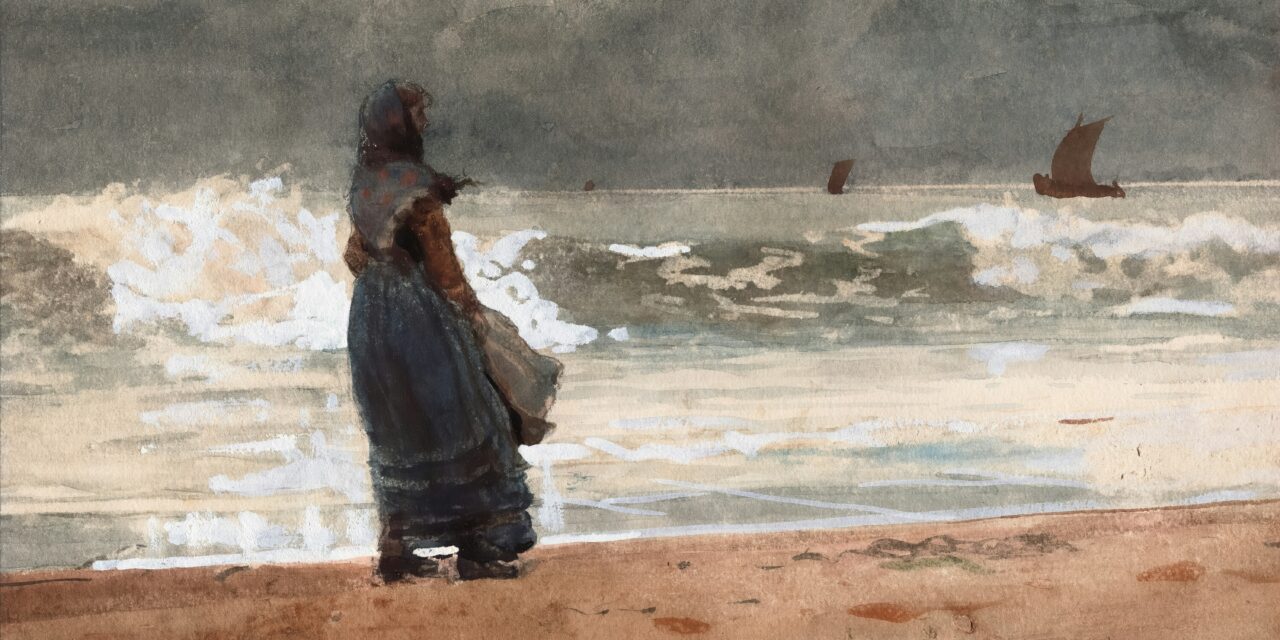
Cullercoats, with its rugged coastline and strong community of fisherfolk, provided Homer with a compelling new subject matter. Living amongst the villagers, he immersed himself in their daily routines, documenting their struggles and triumphs against the unforgiving elements. His paintings from this period, such as “Fisherwomen on the Beach” (1881-82) and “Inside the Bar” (1883), portray the men and women of Cullercoats with a dignity and realism that transcends mere observation. He was particularly drawn to the strong, resilient women of the community, often depicted waiting anxiously for their husbands and sons to return from sea or engaged in the laborious tasks of mending nets and hauling fish. These works are marked by a more sober palette and a heightened sense of human drama as individuals confront the vast, indifferent power of the ocean.
The Influence of the North Sea
The raw power of the North Sea profoundly impacted Homer’s artistic vision. The dramatic weather, the crashing waves, and the ever-present threat of danger permeated his work. This period saw a shift in his artistic focus towards grander, more elemental themes. His Cullercoats paintings exhibit a renewed vigour and a deeper understanding of the interplay between human endeavour and the forces of nature. The experience cemented his reputation as a painter of powerful seascapes and a chronicler of a life lived on the edge.
Prout’s Neck: The Wilderness and the Waves
Upon his return from England in 1883, Homer made a decisive choice to establish his studio in Prout’s Neck, a remote and rugged headland on the coast of Maine. This move marked the beginning of his most iconic and defining period, where he largely retreated from urban life to pursue a solitary existence, dedicating himself entirely to painting the sea and its environs.
Solitude and Creative Intensity
Prout’s Neck offered Homer the isolation and direct access to nature that fueled his creative genius. He built a studio overlooking the Atlantic, allowing him to observe the ocean in all its moods, from tranquil calm to tempestuous fury. This period saw him delve deeper into themes of primal struggle, survival, and the inherent power of the natural world. Living in self-imposed solitude, Homer cultivated an intense focus that allowed him to capture the raw energy and profound beauty of the Maine coast with unparalleled intensity. His art became less about narrative and more about the visceral experience of nature.
Iconic Seascapes and Human Confrontation with Nature
The Prout’s Neck years produced Homer’s most celebrated seascapes, paintings that are both monumental in scale and deeply resonant in their emotional impact. Works such as “The Gulf Stream” (1899), depicting a lone African American man adrift in a dismasted boat surrounded by sharks, is a harrowing meditation on isolation, fate, and the brutal indifference of nature. “Northeaster” (1895) and “The Breaking Wave” (1896) are sublime portrayals of the ocean’s raw power, capturing the dramatic surge and foam of waves crashing against the rocky shore. These paintings transcend mere depiction; they are meditations on existence, the fragility of human life in the face of immense natural forces, and the enduring spirit of survival. Homer’s focus narrowed to often a single figure or a small group, emphasising their vulnerability against the vastness of the ocean.
The Hunter and the Hunted
Beyond the sea, Homer also explored the wilderness of the Maine woods, depicting scenes of hunting and the often-brutal realities of life and death in nature. Works like “The Fox Hunt” (1893) and “Right and Left” (1909), showing ducks plummeting after being shot, are unflinching portrayals of predator and prey, reflecting a Darwinian understanding of the natural world. These paintings, while sometimes stark, are imbued with Homer’s characteristic respect for both the hunter and the hunted, offering a complex view of the cycle of life. He captured the intricate balance within ecosystems, often with a profound sense of melancholy and a recognition of mortality.
For those interested in exploring the artistic innovations that shaped the landscape of American art, a related article can provide valuable insights into the broader context of Winslow Homer’s work. This piece delves into the transformative movements that influenced artists of his time, highlighting how their contributions paved the way for modern expressions in art. To learn more about these artful innovations, you can read the article here.
The Enduring Legacy of Winslow Homer
Winslow Homer passed away in Prout’s Neck in 1910, leaving behind a body of work that profoundly shaped the course of American art. His impact is multifaceted, extending beyond mere subject matter to influence subsequent generations of artists through his unique approach to observation, his masterful technique, and his profound thematic concerns.
A Distinctive American Voice
Homer’s greatest legacy lies in his creation of a truly distinctive American voice in art. Unbeholden to European academic traditions, he forged his own path, drawing directly from the American experience. His work is a powerful testament to the rugged individualism and the profound engagement with the natural landscape that defines the American spirit. He painted America as he saw it, with all its beauty, harshness, and quiet dignity. His art provided a counterpoint to the more romanticised European traditions, celebrating the authenticity of American subjects and the strength of its people.
Mastery of Medium and Technique
Homer’s technical prowess, particularly in watercolour, redefined the possibilities of the medium. He demonstrated that watercolour could be as robust and expressive as oil, capable of conveying profound depth and emotion. His bold brushwork, innovative compositions, and masterful handling of light and shadow set a new standard for artistic excellence. He developed unique techniques, such as scratching into the paper to create highlights or layering washes to build atmospheric effects, which continue to inspire artists today. His ability to evoke the texture of crashing waves or the dappled light filtering through a forest is unparalleled.
Timeless Themes and Universal Appeal
The themes explored in Homer’s work – the struggle for survival, humankind’s relationship with nature, the power of the elements, and the quiet dignity of labour – are universal and timeless. His paintings resonate with audiences across generations and cultures because they speak to fundamental aspects of the human experience. Whether depicting a fisherman battling a storm or children at play, Homer captured moments of profound significance that continue to move and inspire. His art compels us to confront our own vulnerability, our resilience, and our deep connection to the natural world, solidifying his place as one of the most important and influential artists in American history.
FAQs
1. Who was Winslow Homer?
Winslow Homer was an American artist known for his landscapes, seascapes, and marine paintings. He was born in 1836 and is considered one of the greatest American painters of the 19th century.
2. What style of art is Winslow Homer known for?
Winslow Homer is known for his realistic and naturalistic style of art, particularly his depictions of the sea and the American landscape. He is often associated with the American Realist and American Impressionist movements.
3. What are some of Winslow Homer’s most famous works?
Some of Winslow Homer’s most famous works include “The Gulf Stream,” “Breezing Up (A Fair Wind),” and “Snap the Whip.” These paintings are renowned for their depictions of nature and everyday life.
4. Where can I see Winslow Homer’s artwork?
Winslow Homer’s artwork can be found in major museums and galleries around the world, including the Metropolitan Museum of Art in New York, the National Gallery of Art in Washington, D.C., and the Museum of Fine Arts in Boston.
5. What is Winslow Homer’s legacy in the art world?
Winslow Homer’s legacy in the art world is significant, as he is considered one of the most important American artists of the 19th century. His work continues to be celebrated for its technical skill, emotional depth, and timeless portrayal of American life and landscapes.