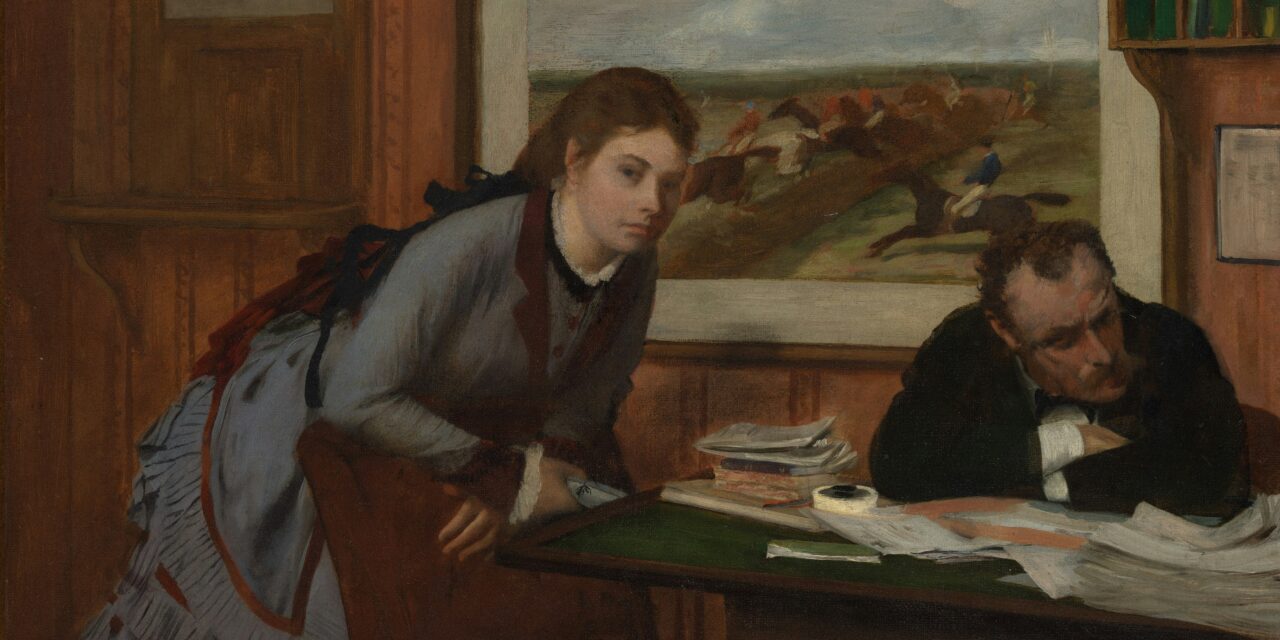
The gas lamps of Paris cast long, flickering shadows as a young man, barely into his twenties, made his way through the bustling streets. He carried a sketchbook, his gaze sharp and unwavering, absorbing every detail – the elegant sweep of a woman’s skirt, the stoic posture of a street vendor, the restless energy of a passing horse. This was Edgar Degas, born Hilaire-Germain-Edgar De Gas in 1834, a man whose life would be inextricably woven with the artistic tapestry of his time, forever challenging conventions and redefining the depiction of modernity.
Born into a world of privilege and intellectual pursuits, Degas’ early life was steeped in the refined atmosphere of a wealthy Parisian family. His father, Auguste De Gas, was a banker of Neapolitan origin, while his mother, Célestine Musson, hailed from New Orleans. This rich cultural heritage would subtly influence his artistic sensibilities throughout his career.
A Classical Education and Early Artistic Stirrings
Degas received a superlative education at the prestigious Lycée Louis-le-Grand, an institution known for nurturing some of France’s greatest minds. Initially, his father harboured hopes of his son pursuing a legal career, and to that end, Edgar embarked on law studies in 1853. However, the pull of art proved irresistible. Even during his legal studies, his passion for drawing was evident, filling notebooks with sketches and observations. It was clear his destiny lay not in jurisprudence, but in the vibrant, expressive world of fine art.
Apprenticeship in the Old Masters’ Footsteps
Recognising his son’s undeniable talent and fervent dedication, Auguste De Gas eventually supported Edgar’s artistic aspirations. This led to his formal training at the esteemed École des Beaux-Arts in Paris. Here, Degas immersed himself in academic traditions, diligently studying the human form and the principles of classical composition. His thirst for knowledge and mastery, however, extended beyond the classroom. He yearned to connect directly with the giants of art history.
In a pivotal move for his artistic development, Degas embarked on several extensive trips to Italy between 1856 and 1859. This period was formative, as he spent countless hours in the hallowed halls of Italian museums and churches, meticulously copying the works of Renaissance masters. Michelangelo’s powerful draughtsmanship, Raphael’s harmonious compositions, and Titian’s luminous colour palettes became his silent teachers. This rigorous, classical training provided him with an unparalleled foundation in draughtsmanship and an understanding of form and structure that would underpin his later revolutionary approaches to modern subjects.
Edgar Degas, renowned for his innovative approach to capturing movement and his fascination with the human form, shares an intriguing connection with fellow artist John Constable, who is celebrated for his landscape paintings that evoke the beauty of the English countryside. For those interested in exploring the life and works of Constable, a related article can be found at this link. Both artists, though distinct in their styles, contributed significantly to the evolution of art in their respective eras, making a comparative study of their lives and techniques particularly enlightening.
The Glimmer of Modernity: Shifting Focus and Defining a Style
The 1860s marked a significant turning point in Degas’ artistic trajectory. Having thoroughly absorbed the lessons of the past, he began to turn his keen eye towards the present, shifting his focus from grand historical narratives to the quieter, more intimate dramas of contemporary life. This pivot would define his legacy and position him at the vanguard of a burgeoning artistic movement.
From Historical Narratives to Parisian Life
Initially, Degas engaged with history painting, producing works that adhered to academic conventions. However, as the decade progressed, a growing fascination with the mundane yet compelling aspects of Parisian life began to manifest in his canvases. He started depicting subjects that resonated with the changing social landscape of the Second Empire: the bustling boulevards, the quiet intimacy of café scenes, the solitary figure of a laundress, and, most famously, the world of the ballet.
The World of Performers and the Human Form
Degas became unparalleled in his ability to capture movement and fleeting gestures. His fascination with the human form in motion led him to explore the behind-the-scenes world of the opera and the ballet. He was not merely interested in the glamorous spectacle on stage, but in the arduous training, the awkward stretches, and the moments of respite in the wings. His dancers, often caught in unguarded poses, reveal a raw authenticity that transcended mere prettiness. Similarly, his depictions of actresses, singers, and musicians offered a glimpse into the demanding lives of performers, imbued with an observational empathy that was both rare and profound.
The Equine Kingdom: A Fascination with Movement
Beyond the theatre, Degas found another captivating subject in the world of horses. His passion for racing and the equestrian world allowed him to further hone his ability to render motion and power. From the thundering hooves of racehorses to the elegant stride of dressage mounts, Degas meticulously studied their anatomy and dynamism. His equine studies, like his ballet dancers, are characterised by a deep understanding of structure and an astonishing ability to convey kinetic energy.
The Impressionist Circle: Maverick or Ally?
The latter half of the 19th century witnessed a seismic shift in the art world, with a group of radical young artists challenging the established Salon system. Degas, despite his strong individualistic streak, found himself drawn into this revolutionary circle, becoming a key figure in the Impressionist movement.
A Core Member, Yet an Independent Spirit
Degas played a crucial role in the organisation and exhibitions of the Impressionist group. He was instrumental in establishing their independent exhibitions, providing a vital platform for artists whose work was routinely rejected by the conservative Salon. He participated in most of their eight exhibitions, often acting as a driving force and a figure of considerable influence. However, Degas always maintained a distinctive artistic vision and a certain distance from the core tenets of Impressionism. He preferred the term “Realist” or “Independent” to describe his work, eschewing the Impressionists’ focus on capturing transient light effects and painting en plein air. His emphasis remained firmly on draughtsmanship, composition, and the meticulous rendering of form, often working from memory or sketches in his studio rather than directly from nature.
A Master of Observation, Not Just Impression
Degas’ “Realism” was rooted in his extraordinary powers of observation and his ability to distill complex human interactions and movements into compelling visual narratives. He meticulously studied human behaviour, gestures, and settings, often employing unconventional viewpoints and cropping techniques influenced by photography and Japanese prints. This allowed him to create compositions that felt spontaneous and unposed, offering a more immediate and intimate connection to his subjects than many of his Impressionist contemporaries. While Monet sought to capture the fleeting impression of light on a landscape, Degas delved into the psychological depth and social realities of his urban environment.
The Shadow of War and the Changing Light
The turn of the 1870s brought with it significant upheavals, both on a national and personal level, which would profoundly impact Degas’ life and work. The Franco-Prussian War and its aftermath coincided with the insidious onset of a debilitating physical condition.
Serving the Nation and the Onset of Adversity
In 1870, with the outbreak of the Franco-Prussian War, Degas, like many patriotic Frenchmen, answered the call to duty. He served in the National Guard, an experience that, while brief, brought him into contact with a different facet of Parisian life and undoubtedly left its mark. More significantly, it was around this period that Degas began to experience serious problems with his eyesight. Initially, it manifested as difficulty working in bright light, but over time, it would steadily worsen, casting a long shadow over his artistic productivity and his ability to engage with the world.
A Sojourn in New Orleans: Family Ties and New Perspectives
In a period of personal and national flux, Degas embarked on a significant journey across the Atlantic. From 1872 to 1873, he travelled to New Orleans, his mother’s birthplace, to visit his family, including his brother René and their various relatives. This trip provided him with a new source of inspiration. He painted portraits of his family members, capturing the languid atmosphere of the American South and the nuances of contemporary life in a different cultural setting. These works, while perhaps less numerous than his Parisian output, offer a unique glimpse into Degas’ versatility and his ability to find artistic fodder in any environment. They also mark a period of introspection and a temporary respite from the pressures of the Parisian art scene.
Edgar Degas, renowned for his captivating depictions of ballet dancers and everyday life, has a fascinating life story that intertwines with the broader context of the Impressionist movement. For those interested in exploring the artistic journeys of other influential figures, a related article can be found at Artful Adventures, which delves into the lives and works of various artists who have shaped the art world. This resource provides valuable insights into the creative processes and personal experiences that define these remarkable individuals.
The Waning Light: Blindness and Solitude
The final decades of Degas’ life were increasingly marked by the relentless progression of his blindness, a cruel twist of fate for an artist whose very existence depended on his acute visual perception. This decline forced significant changes in his artistic practice and ultimately led to a period of profound solitude.
The Tyranny of Diminishing Sight
As the years advanced, Degas’ eyesight continued to deteriorate, a slow and agonizing process for an artist of such visual acuity. This progressive blindness gradually curtailed his ability to execute the intricate details that had been a hallmark of his earlier work. He found it increasingly difficult to draw and paint with the precision he desired. This forced him to adapt his techniques, leading to a looser, more expressive style, particularly in his pastels and sculptures. His pastels, in particular, became bolder, with broader strokes and more vibrant colours, reflecting his struggle to perceive fine lines and subtle gradations. The tactile nature of sculpture also offered a means of artistic expression as his sight failed, allowing him to create with his hands what his eyes could no longer clearly see.
A Life Unmarried and the Embrace of Solitude
Throughout his life, Degas remained a private and solitary individual. He never married and had no known romantic relationships, dedicating himself almost entirely to his art. As his blindness progressed and his social interactions became more challenging, this innate solitude deepened. He stopped working altogether around 1912, succumbing to the limitations imposed by his failing vision. The once-bustling studio, filled with the energy of artistic creation, grew quiet.
His final years were spent largely in isolation, wandering the streets of Paris, a ghostly figure in the city he had so brilliantly captured in his prime. The artist who had once keenly observed every detail of urban life was now navigating it with increasing difficulty, his world shrinking around him. He became a familiar sight, an elderly, almost mythical figure, a testament to a bygone era of artistic revolutions.
The Final Chapter: Legacy and Lasting Impact
Edgar Degas died in Paris in 1917, at the venerable age of 83. His passing marked the end of an extraordinary life, one dedicated entirely to the relentless pursuit of artistic truth and innovation. Though his final years were shrouded in the dimness of blindness, his artistic legacy remains luminously clear. From the classical foundations of his early training to his revolutionary depictions of modern life, Degas consistently challenged conventions, offering a fresh, often unflinching, perspective on the human condition and the dynamic world around him. He blurred the lines between academic tradition and avant-garde experimentation, creating a body of work that continues to captivate and inspire, firmly establishing him as one of the most significant and influential artists of the 19th century. His meticulous observations, his mastery of form and movement, and his uncompromising vision ensured that his insights into the human drama would endure long after his own sight had faded.
FAQs
Who was Edgar Degas?
Edgar Degas was a French artist famous for his paintings, sculptures, prints, and drawings. He is best known for his depictions of dancers and racehorses.
What was Edgar Degas’s early life like?
Edgar Degas was born on July 19, 1834, in Paris, France. He came from a wealthy family and received a classical education before studying at the École des Beaux-Arts.
What were some of Edgar Degas’s most famous works?
Some of Edgar Degas’s most famous works include “The Dance Class,” “L’Absinthe,” “The Bellelli Family,” and “The Tub.”
What was Edgar Degas’s artistic style?
Edgar Degas was associated with the Impressionist movement but preferred to call himself a realist or independent. He was known for his use of bold compositions and innovative perspectives.
What was Edgar Degas’s legacy?
Edgar Degas’s work had a significant impact on the development of modern art. His innovative compositions and exploration of movement and light continue to inspire artists to this day.